Disability Is More Than What We Can See
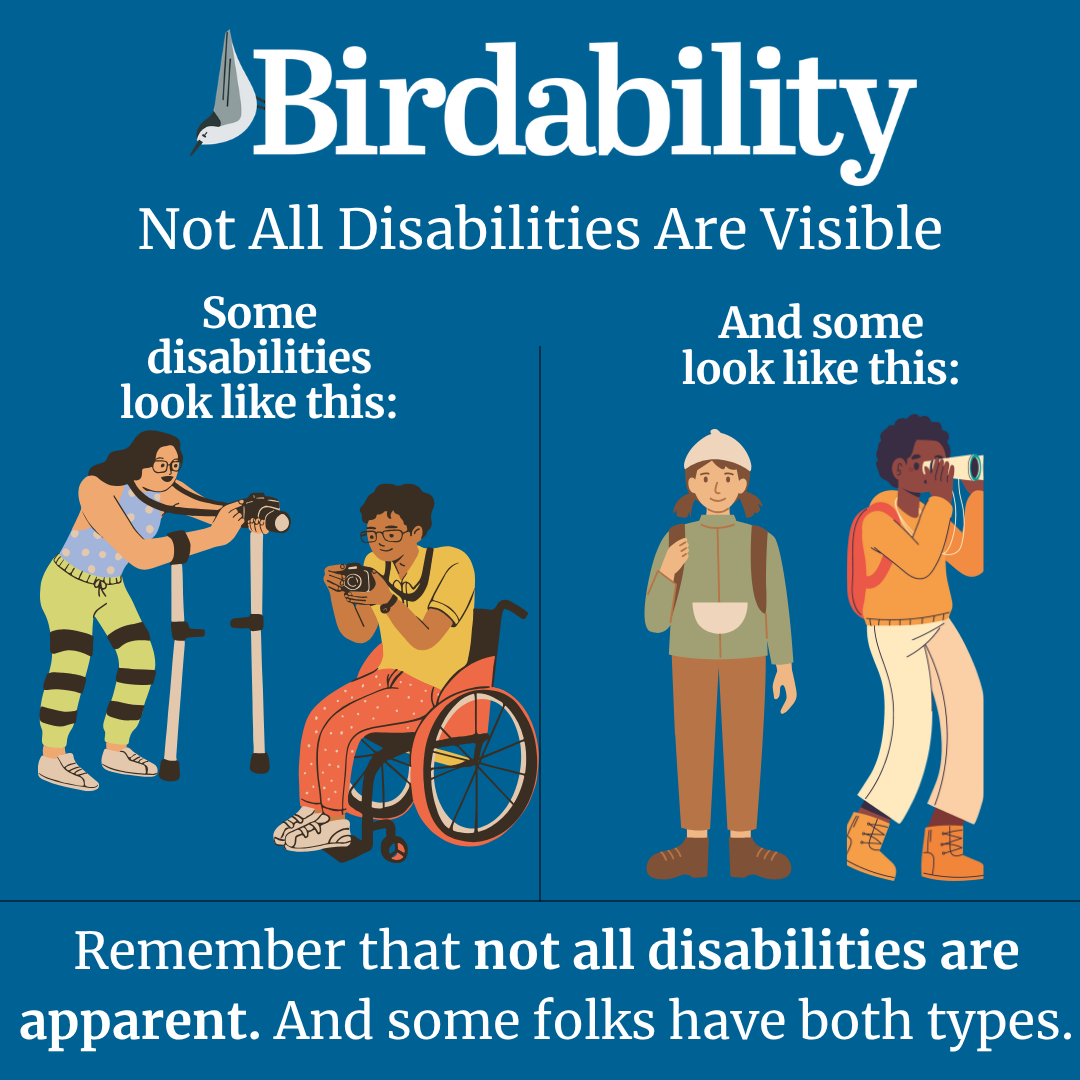
When many people picture disability, they picture something visible to them: a wheelchair, a white cane, crutches, a mobility scooter, a service dog, or another outward sign that someone moves through the world in a particular way.
Those are all part of disability, of course, but they are nowhere close to the whole story.
An estimated 70-80% of all disabled people live with disabilities that are not immediately apparent to the people around them. These can include chronic pain, fatigue, dizziness, brain injuries, mental health disabilities, learning differences, neurological conditions, chronic illnesses, and hearing or vision disabilities. A person may be significantly affected by a disability even when someone looking at them has no idea it is there.
You may hear these described as invisible disabilities or non-apparent disabilities, and at Birdability we use both terms interchangeably.
The Invisible Disabilities Association uses the term invisible disability to describe physical, mental, or neurological disabilities that are not obvious to others but can affect a person’s movement, senses, energy, cognition, communication, activities, and daily life. For many people, the word invisible speaks directly to the experience of having a disability that is overlooked, misunderstood, questioned, or dismissed.
Other people prefer the term non-apparent disability. A fact sheet from Utah State University’s Institute for Disability Research, Policy & Practice explains that words such as invisible or hidden can suggest that the disability itself is somehow absent. It is not. The disability is present in the person’s body, mind, senses, energy, or daily life. It simply may not be apparent to someone else.
There is always room for people to use the language that best fits their own experience, and so we use both terms interchangeably. Disability language is personal, and there does not need to be one single term that works for everyone.
What is more important is understanding that we cannot know what someone is experiencing simply by looking at them.
We cannot see another person’s pain level. We definitely cannot see fatigue, vertigo, brain fog, PTSD, sensory overload, the effects of a traumatic brain injury, a heart condition, treatment effects for cancer, chronic illness, hearing loss, low vision, or the amount of energy someone is already using just to participate in a space that may not have been designed with them in mind.
The World Institute on Disability writes about the discrimination people with non-apparent disabilities can experience, including assumptions that they are not disabled because others cannot see their disability. The Center for People With Disabilities also discusses the disbelief and unrealistic expectations that can come with invisible disabilities, particularly when someone’s needs do not match what other people think disability is supposed to look like.
For many disabled people, that can mean having to explain themselves over and over again.
Why do you need that chair? Why are you parking there? Why are you leaving early? Why are you sitting down? Why can’t you keep up? Why do you need captions? Why do you need a break? You did this yesterday, so why can’t you do it today?
This is especially important to pay attention to when we talk about disabilities and other health concerns that fluctuate. Someone may be able to walk one day and use a wheelchair another. They may have the energy for a longer outing one week and need to bird from home the next. They may be able to hear some sounds and not others, or they may be able to participate fully for part of an event and need to leave before it is over.
None of that makes their disability less real.
Bodies and minds do not operate on a fixed schedule, and many disabilities change from day to day or even hour to hour. Pain changes. Fatigue changes. Symptoms change. Environmental conditions change. The amount of energy required to navigate an inaccessible space changes, too.
Our understanding of access has to be flexible enough to make room for that.
What does this have to do with birding?
Quite a lot.
Birding culture still carries many assumptions about what participation is expected of folks at outings and events. We are often encouraged to get up early, walk farther, stay longer, keep up with the group, travel to the hotspot, stand for long periods of time, hear every call, scan quickly, and push through discomfort in order to see one more bird. Each of these contributes to a cultural perception of who is a “real birder”.
A birder living with chronic fatigue may need a shorter outing. Someone with chronic pain may need a place to sit. A birder with vertigo may need a stable place to bird rather than standing and looking overhead. A person with PTSD or another mental health disability may benefit from knowing in advance how many people will attend, what the environment will be like, where the bathrooms are, how long the outing will last, or whether it is okay to step away.
A birder with a neurological disability may need additional processing time or clear, direct information. Someone who is d/Deaf or hard of hearing may need visual communication, captions, ASL interpretation, or other ways to receive information that do not depend on sound. Someone with low vision may benefit from detailed verbal descriptions, high-contrast materials, tactile information, or other ways of experiencing the birds around them.
And sometimes a person simply needs to say, “This is what works for me,” without also being expected to explain their medical history.
Access should not depend on disclosure
One of the most useful things we can learn from conversations about invisible and non-apparent disabilities is that people should not have to identify themselves as disabled before we think about access.
If we wait until someone discloses a diagnosis and asks for an accommodation, much of the responsibility has already been placed on the disabled person.
There are so many things we can do before anyone has to ask.
We can include clear accessibility information in event descriptions. We can tell people how far we plan to travel, what the trail surface is like, whether there is seating, where bathrooms are located, how long the program lasts, and whether people are welcome to leave early or take breaks. We can provide chairs without deciding who appears to need one. We can build rest into programs. We can offer captions and ASL interpretation. We can provide multiple ways to participate.
And we can make room for birding from a bench, a car, a window, a backyard, a balcony, a hospital room, or a bed.
Accessibility becomes much more meaningful when people do not have to prove that they deserve it.
Believe people
The Invisible Disabilities Association talks about the importance of believing people whose disabilities, illnesses, pain, or other symptoms may not be apparent to those around them.
Believe people when they say they are in pain. Believe them when they say they are tired. Believe them when they tell you that something they could do yesterday is not possible today. Believe them when they ask for an accommodation or use an access tool you did not expect them to need.
And believe people without requiring them to tell you why.
We are not entitled to someone else’s diagnosis in order to respect what they tell us about their body, mind, energy, or access needs.
Making room for the disabilities we cannot see
Disability is much more diverse, varied, and present in our communities than most of us have been taught to recognize.
Some disabilities are immediately apparent. Others are not. Some become apparent in certain environments or circumstances. Some fluctuate. Some people proudly use the word invisible. Others prefer non-apparent. Some use different language altogether.
We do not need everyone to use the same words. What we do need are communities where people are not required to make their disabilities visible before their access needs are taken seriously.
For birding organizations, outing leaders, land managers, and fellow birders, that means moving away from thinking or asking themselves, “Does anyone here look like they need accessibility?”
A much better question is:
What can we do so people with many different bodies, minds, senses, energy levels, and ways of moving through the world can participate here?
That question leaves room for a much bigger birding community.
Learn more
The Invisible Disabilities Association offers education and resources about invisible disabilities and the experiences of people whose disabilities may not be readily apparent.
The Institute for Disability Research, Policy & Practice at Utah State University has a useful fact sheet about definitions, terminology, and categories of non-apparent disabilities.
The World Institute on Disability explores the experience of living with a disability that may not be visible to others.
The Center for People With Disabilities offers additional information about invisible disabilities, common misconceptions, and the barriers people experience.
At Birdability, we will keep working toward birding communities where people can name what they need, participate in the ways that work for them, and know they belong without having to prove why.
