
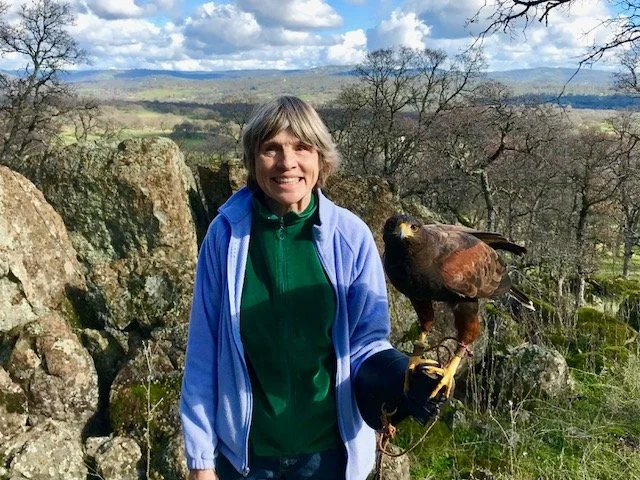
Image description: The author, Susan Glass, flying a Harris Hawk with a trained Falconer in Marysville California (all appropriate federal permits were in place). My first experience listening to birds while sleeping outside was at the bottom of a swimming pool.
An empty pool, a pool only halfway constructed. It belonged to our next door neighbors the Villandinghams, and on the June evening when my brother and sister and Joan and John V slept there, only the cement interior was installed. No plaster coated its inner walls and there was no water as yet. We dragged chaise lounges into the deep end, spread sleeping bags and pillows on them, and lay down to gaze at the stars and listen to the ‘rivet rivet’ of Pacific Chorus frogs. Six weeks from now we’d be under water. How funny! How fun! Lawn chairs under water in a swimming pool.
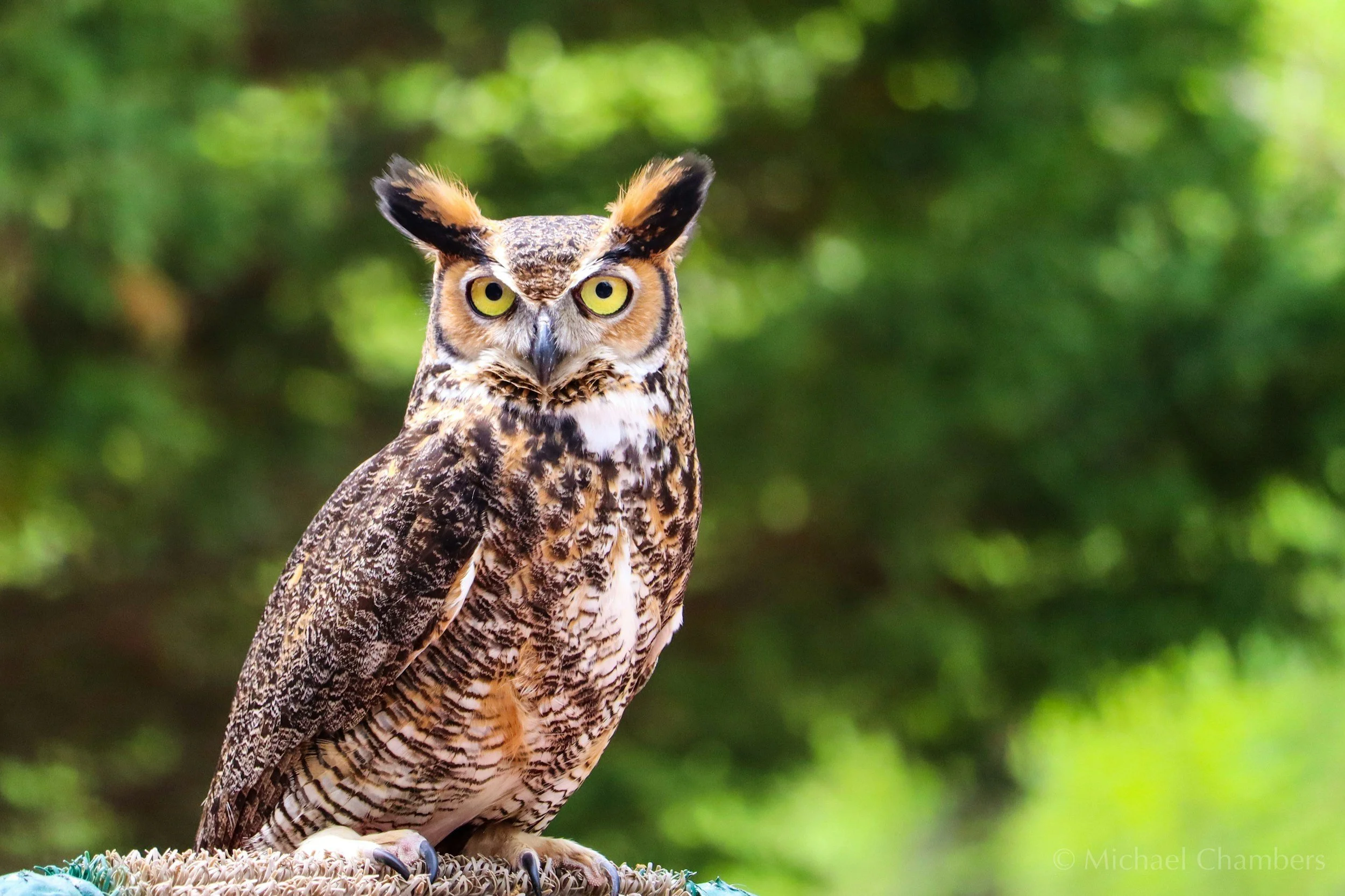
Image description: A Great-horned Owl looks directly at the viewer with large golden eyes and two long ears atop their head. The Great Horned Owl is a large bird with conspicuous "ear" tufts, a white throat, and horizontal bars on the belly. Photo courtesy of Unsplash by Michael Chambers @mchambers140I was only 5 years old, so I dropped off to sleep early, wakened throughout the night by the rollicking song of a Northern Mockingbird, the sonorous hoots of a Great Horned Owl, the crowing of a rooster at Peak’s Dairy, and the intermittent croaking of the frogs.
At some point I opened my eyes to dawn light. I felt − how shall I say— part of something miraculous: sound and light enfolding the night and the dawn, igniting the world. Superimposed over all this was the acoustic signature of the empty swimming pool. I did not think these things; I felt them.
I felt them again as I read Birdsong By The Seasons: A Year Of Listening to Birds. A lifelong
ornithologist as well as an ornithology professor, Kroodsma’s writing combines precise scientific observation of birds with acute, trained listening, animated visual descriptions, and a poet’s sense of wonder and curiosity about the complexity and variety of bird life. He’s not at all afraid to speculate about what birds might be thinking and feeling even if doing so isn’t scientific, even if we human listeners will never definitively know the answers to such questions. Best of all (and this is my connection to sleeping in the swimming pool) Professor Kroodsma has also spent nights in some pretty unusual places in order to listen to birds: an observation tower above a swamp where alligators rumble; a beach in Nicaragua where Great Kiskadees call; a Pawnee National grassland prairie before dawn where the skies tumble with lark song and lark acrobatics.
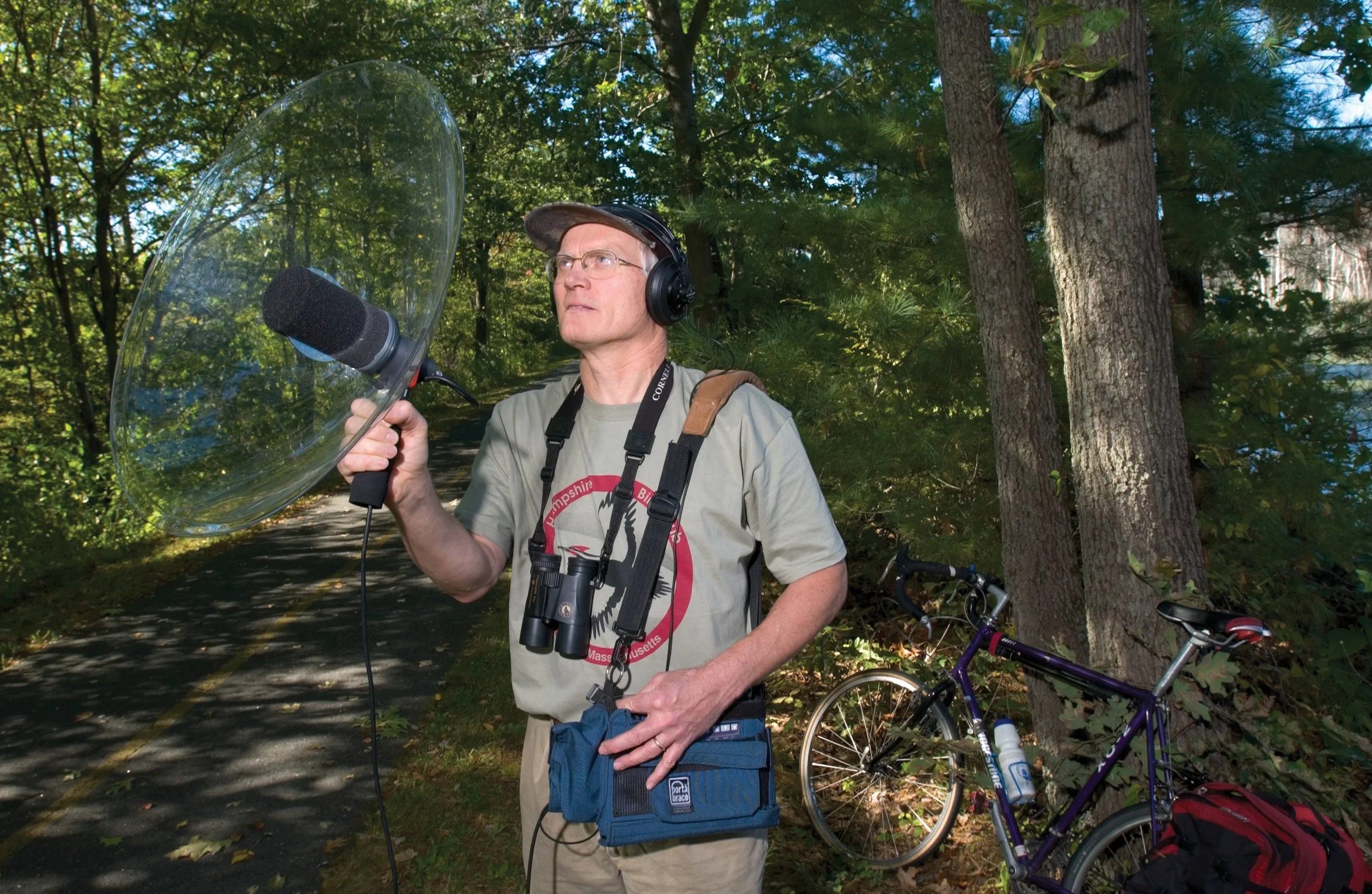
Image description: Author Donald Kroodsma stands beside a paved, wooded path recording birds. He wears headphones and binoculars and holds a large parabolic microphone pointed toward the trees. A bicycle rests against a tree behind him. Sunlight filters through the green foliage surrounding the path.You won’t find a more affable birding companion than Donald Kroodsma. Armed with a gentle sense of humor, a bicycle, recording equipment, a trailer for towing said equipment behind the bike, a camp chair, and mosquito netting, Kroodsma leads us through 12 months and 4 seasons of bird listening throughout North and South America. The bird recordings with which he documents this year long journey will enhance your reading. The book is accompanied by the set of supporting CD’s that Kroodsma recorded, as well as a listening guide that allows you to follow along chapter by chapter as he visits Pileated Woodpeckers in Amherst Massachusetts, Limpkins in Florida, and Banded Wrens in Nicaragua to name just a few were the birds you’ll listen to and meet.
In addition to the print version of the book which is available from Buteo Books, blind and low vision readers can also request an audio copy from NLS BARD with all of the bird recordings embedded contextually within the narration.
I’m a totally blind BARD user (BARD is the Braille and Audio Reading Download service from the National Library Service for the Blind and Print Disabled Downloadable Books and Magazines), so I ordered the audio copy and purchased a hard copy from Buteo to help support Birdability. In my opinion the audio version is well worth hearing. It’s read engagingly by Dan Wallace, whose enthusiasm for the text feels as palpable as Kroodsma’s.
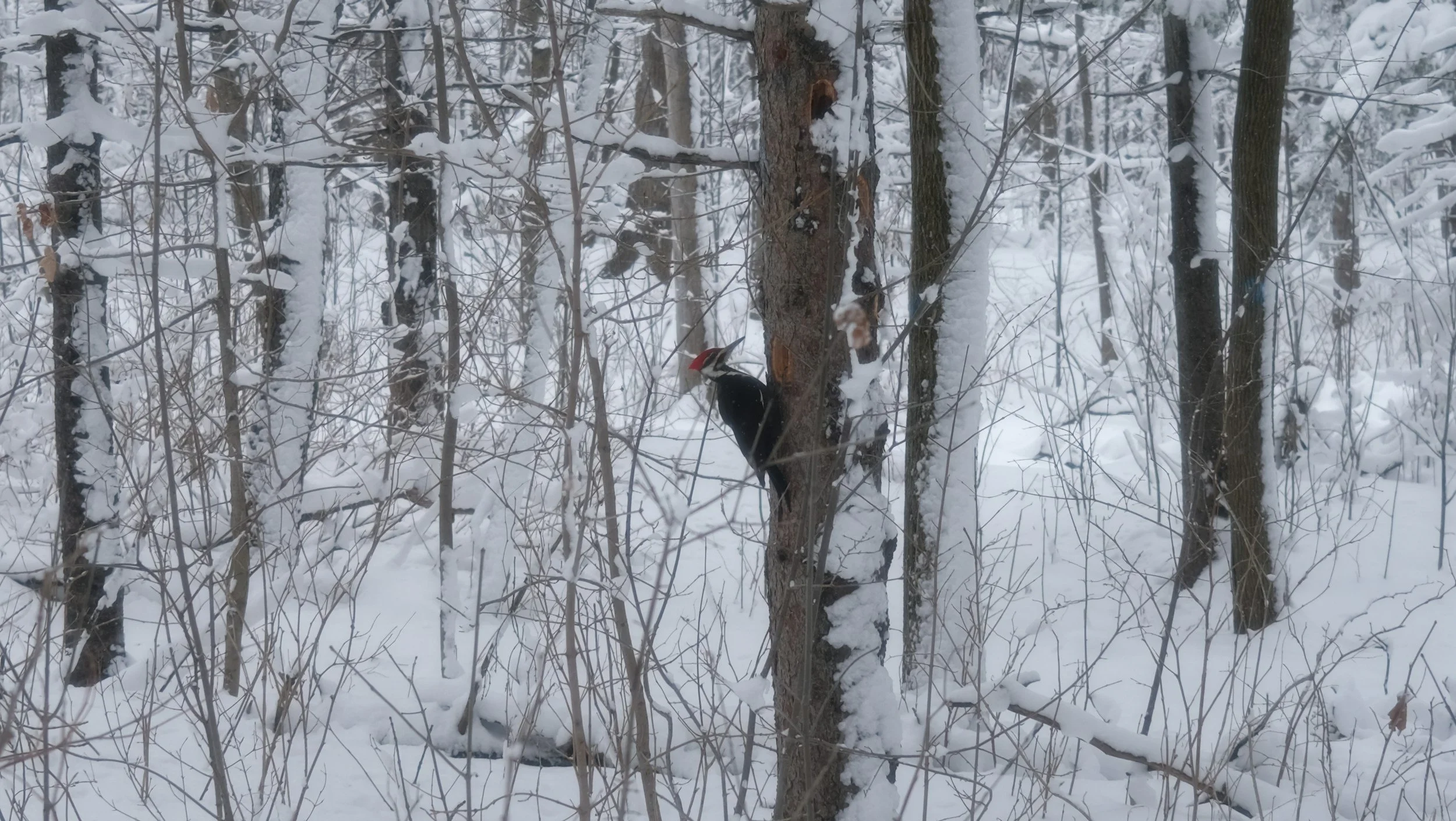
Image description: A Pileated Woodpecker perches on a tree in the midst of a snowy forest of trees. There is a large hole excavated out of the other side of the tree trunk from the woodpecker. Photo courtesy of Unsplash by Zahraa Hassan @z4hr44Birdsong begins at dawn on a New Year's Day near the roost of a Pileated Woodpecker in Amherst, Massachusetts:
“I know she’s in there. Off the edge of the paved rail-to-trail bike path where I sit, it's just 50 feet to the east across the open ice, the lone dead oak tree, then up the stump ten feet to the 5-inch diameter hole. She’s out of sight just below that entrance, still sleeping, no doubt, as none of the other day birds are stirring yet either. I hear only the great horned owls now, three pairs of them hooting back and forth to one another, getting in their last licks before daylight. Their hormones are flowing midwinter, as this is their breeding season, and soon they’ll have eggs and young at what seems the oddest time of year. One pair is at least a quarter mile to the east, beyond the railroad tracks on the other side of this beaver-made lake. Another pair is behind me, toward South E Street, and the third is to my right in the depths of the Lawrence Swamp Forest. In each pair I hear the female and male dueting, her tones slightly higher pitched than his.”
Wow! We’ve come here to listen to and observe one woodpecker, and are treated to a full soundscape and (this is crucial) to a “bird sit”. If we sit still, the birds often come to us.
The narrative continues:
“Yes, I know she’s in there, because I saw her enter late yesterday afternoon at 3:44 pm on New Year’s Eve to be exact, almost three quarters of an hour before the actual sunset. It was a grand entrance, too, entirely unexpected. I was sitting quietly in my camp chair, watching the old oak that had housed a pileated family just this past summer and wondering if anyone was roosting in the cavity over the winter. By 3:20, with the goal of recording anything I might hear, I had started my recorder, pointed the microphone at the nest hole, and laid the recorder and mic on a pack beside me…
I first hear her, calling in flight, a wild kuk-kuk-kuk-kuk-kuk-kuk-kuk, seven or eight a second, and I then see her, too, in undulating flight, coming right toward me. It is a six-second announcement she makes as she approaches, kuk-kuk-kuk-kuk-kuk-kuk-kuk, and then Thunk! as she lands in a beanpole of a tree trunk perhaps 30 feet to the right of the nest cavity and about 20 feet up. She continues calling, kuk-kuk-kuk-kuk, more slowly now, and a little lower-pitched; my eyes are glued to her features. A female! A young female! Her scarlet red crest is raised and glowing in the evening sun, her malar stripe black, her pitch-black eye as intense as her calls are now wild and uneven, the spacing irregular, a loud, laughing, primeval cackle.”
If you’re listening to the audio book, make sure you wear your headphones at this point so you can hear the rhythm of those calls, and that otherworldly, primal cackle. If you’re reading the print copy, find the woodpecker recording on the accompanying CD and take a good listen.
Kroodsma informs us that this Pileated Woodpecker weighs nearly a pound, and has an outstretched wing span of 2 and a half feet.
“I note the stiffened tail feathers, propping her up against the vertical trunk; the distinctive head and neck pattern, black and white topped with a red crest, a yellowish brown crown between the crest and the bill. And the feature I most remember, the pitch-black eyes, confirming that she hatched just this past summer and is only half a year old.”
I love the crystalline accuracy of these passages, but also their tone of wonder and discovery. And I enjoy Kroodsma’s curiosity as he watches and listens. What is she doing for a full 15 hours in that nest hole, he asks himself? Sleeping yes, but for the entire time? And what’s on her mind as she cackles? What is she feeling? Why does she make such a big show of flying to her roost at dusk on New Year’s Eve, and then utter barely a sound when she emerges on New years Day morning? How anticlimactic, he muses!
It’s the occasional whimsicality Kroodsma brings to his writing that most charms me, and the way such whimsicality leads to thoughtful speculations and analogies. In chapter 5, Florida Scrub Jay Families, he compares the extended family structures found in scrub jay society, to human extended families. The scrub jay family he and fellow ornithologists are studying is located at Archbold Biological Station, Lake Placid, Florida. They’ve named it the Crossroads Family, and it’s one of 60 families at Archbold where the jays have been marked and banded and studied since 1969. At least 4 or 5 species of scrub oak grow there, most no more than waist to shoulder high. Natural fire cycles occur every 5 to 15 years, and these fire cycles help maintain the scrub community that’s necessary for the jays to thrive. An extended scrub jay family will occupy a particular territory, with older siblings often remaining on site for a year or more to help raise their younger brothers and sisters before seeking mates of their own. Often they’ll take up with a widow or widower on an adjacent jay territory.
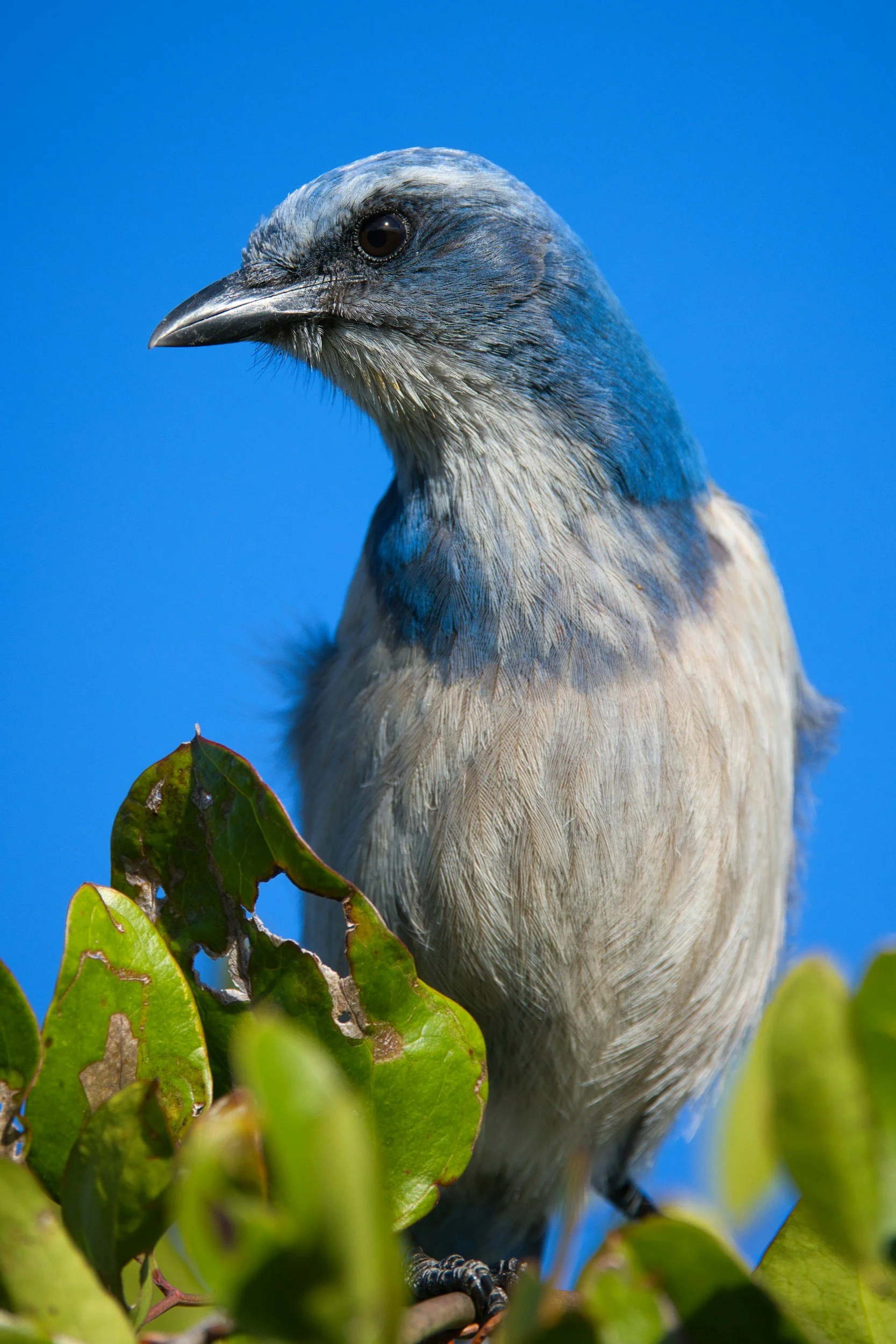
Image description: A Florida Scrub Jay perched at the very top of a leafy tree with feathers and eye captures in fine details with the sun shining on the bird directly. Photo courtesy of Unsplash by David Valentine @thephotochadSuch is the case with the family that Donald Kroodsma is observing. There’s a mother jay, a father jay, and a daughter jay who is nearly 2 years old. This daughter jay is now helping to raise her 4 younger siblings: 2 male jays and two female jays. The jays are identified by the leg bands they wear: “That adult male breeder is “Purple Aluminum left, Green right”, but what if I dared to give him a name, like Al?”, Kroodsma speculates.”And his mate, is she “Aluminum left, Blue over Red right,”or is she, say, Betty?”. “I’m almost shocked that naming them was so easy, but I wouldn’t have dared to name them before I retired from the academic world, as my peers would have frowned heavily on me, and peers, sometimes for better and sometimes for worse, police one another.”
Scientists are supposed to be objective, and they must never anthropomorphize. That at any rate, is what they are taught. Jane Goodall was roundly criticized when she assigned names to the chimpanzees she was studying instead of numbering them, and geneticist Barbara Maklintok took heat for titling one of her academic papers “Listening To Corn”. Objectivity is a sound standard for which to strive, but it can be a difficult standard to assume and maintain when we’re living inside our subjective skins. Kroodsma assigns human names and family designations to all in the jay family as he observes them: the elder daughter-jay Cindy, her 4 younger siblings Lilly and Linda, Roy and Ron, and the “widowed” jay with whom Cindy eventually mates. Far from detracting from the science found here, I think the names enliven the human family, jay family analogy.
At one point, Kroodsma’s friend and fellow ornithologist Glen Woolfenden asks to read the report he’s written about the jays, and Kroodsma confesses to feeling anxious about what Glen will think of his having named the birds. But on finishing Kroodsma's report, Glen looks up, smiles, and says,”Everyone who works with the jays starts to think of them as people.”
The recordings of jay vocalizations taught me much. I learned for instance, that female jays utter a hiccup, call when courting male jays. The males never make this call. Female jays also have a particular rattle call. Where I live in California, I’ve heard Steller’s Jays make such a rattle. Now I know that when I hear it, I’m hearing a female.
I’ve read Birdsong several times now, and once I followed it through its calendar year, reading just one chapter a month, the January chapter in January, the February chapter in February and so on. Doing this heightened my appreciation for the joy and scholarship found here, allowing me to slow down and live each of my own bird months more deeply than I would have otherwise.
I highly recommend that you check out chapter 18, “Young Of The Year Practice Their Songs”. Therecordings of juvenile Warbling Vireos, Tufted Titmice, Song Sparrows, and Black Capped Chickadees practicing their songs will likely remind you of babbling human babies learning to speak. Listening on my own I’d have been hard pressed to identify who I was hearing, but Kroodsma’s commentary and practiced ear brought these wood-be songsters into clear focus.
He also discussed the differences between songbirds who must learn their songs, and fly catchers, whose songs come packaged in their genetic code.
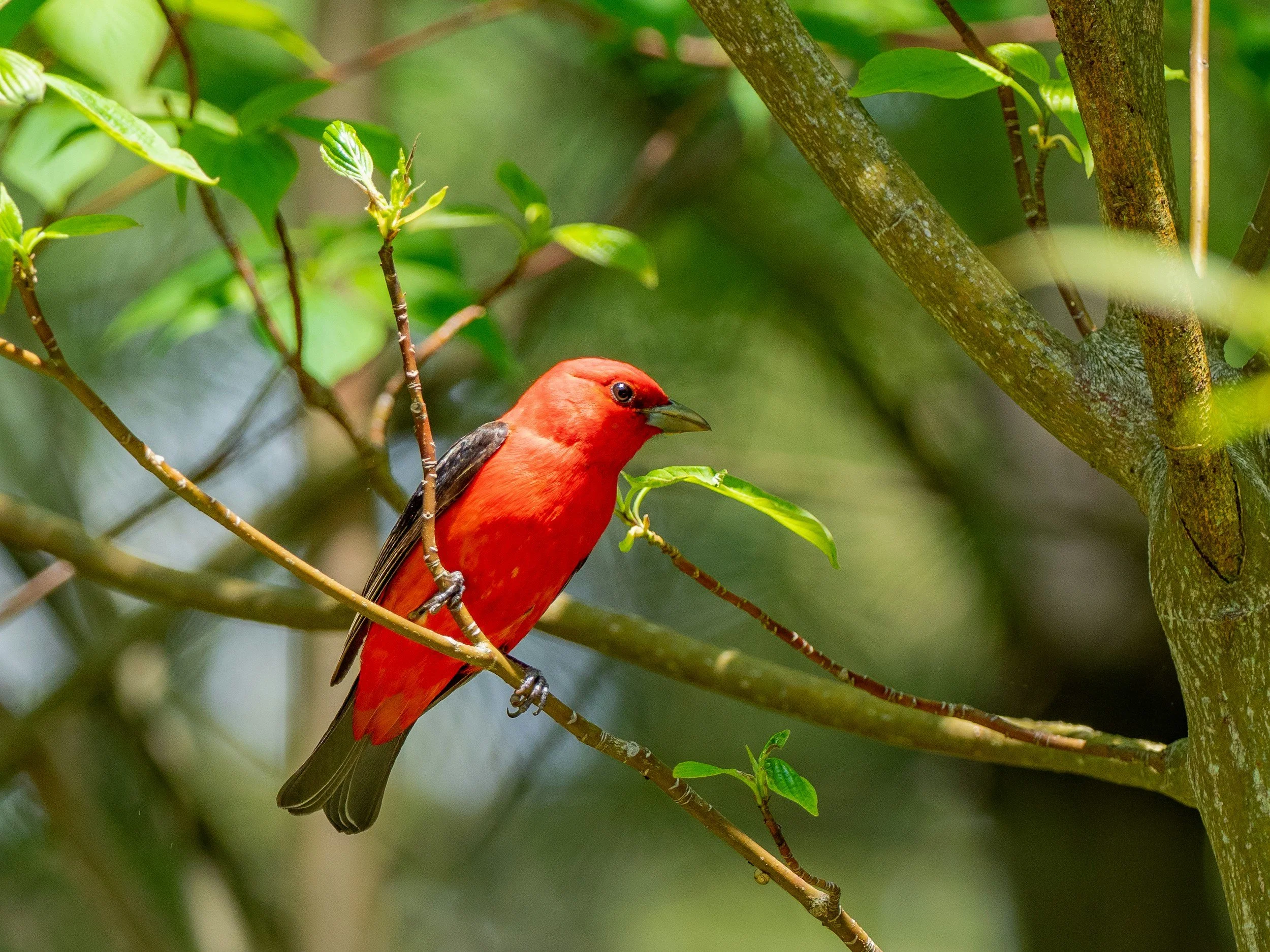
Image description: A Scarlet Tanager perches in a leafing-out green tree, the brilliant red of the bird offset by the black wings and dark tail feathers. Photo courtesy of Unsplash by Patrice Bouchard @patricebI learned something new from every chapter in this book: Take for instance, the “Dawn and Day Songs of Scarlet Tanagers”. I didn’t know there were differences between dawn and day songs. And, ”Baltimore Orioles She Sings Too”. It turns out that females of several bird species sing.
The chapter on Flight Calls of nocturnal migrants made me yearn to install microphones on top of my house. And the chapter documenting how Costa Rican Bell Birds have steadily lowered the pitch of their whistles over the last several years amazed me. Male Bell Birds learn their songs, and every male must learn from and keep pace with the males around him as they lower the pitches of their whistles. Why do they lower them? No one knows.
Indeed there’s so much we still don’t know about birds, who arrived on earth long before human beings, who sang and called within earshot of our pre-human ancestors, and who, if we are good enough stewards of earth, will be with us for ages to come.
The reviewer, Susan Glass shares, "I'm 70 years old, and it feels to me as if I've loved birds for my entire life, but definitely since before I could talk. I'm totally blind but for light perception, and have been so since birth. Birding by ear is my favorite outdoor pastime. Professionally I worked as a creative writing and literature professor, but always the outdoors called to me via horseback riding, hiking with guide dogs, and list-ing to birds. I've had a couple stunning birding adventures: flying a Harris Hawk, and helping band a White Throated Swift. But most of the time I'm a slow birder, one who loves bird sits, being as quiet as possible, and letting the birds speak to my ears when they are ready to do so."
