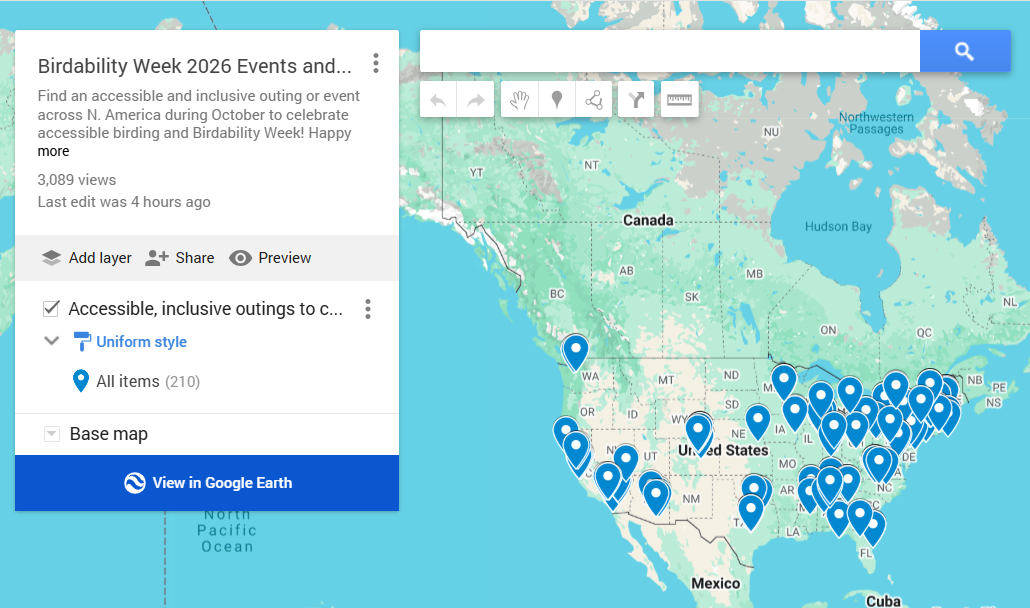
Image description: Screenshot of the Birdability Week 2026 Events map in Google My Maps. A map of the United States and southern Canada is covered with blue location pins marking accessible and inclusive Birdability Week events, with especially dense clusters across the eastern U.S. and additional pins across the Midwest, South, Southwest, West Coast, and Canada. A panel on the left reads “Birdability Week 2026 Events and…” and says, “Find an accessible and inclusive outing or event across N. America during October to celebrate accessible birding and Birdability Week!” The map layer shows “All items (210)” and the map has received 3,089 views.I added two more events to the Birdability Week map today - a few days into the week itself!
That brings us to 210 accessible and inclusive events and outings for Birdability Week 2026.
Two hundred and ten!
I have spent a lot of time with this map over the past few months. I have read event submissions, looked at trail descriptions, fixed addresses, asked follow-up questions, gotten excited about benches and accessible parking and creative programming, and watched new pins appear in places I hoped Birdability Week events would reach someday.
And somewhere along the way, I realized I was looking at something much more interesting than a really big event calendar. I was looking at 210 different answers to the question: What could birding look like if we stopped assuming everyone had to do it the same way?
And people have come up with some REALLY good answers.
What if the birds came to us?
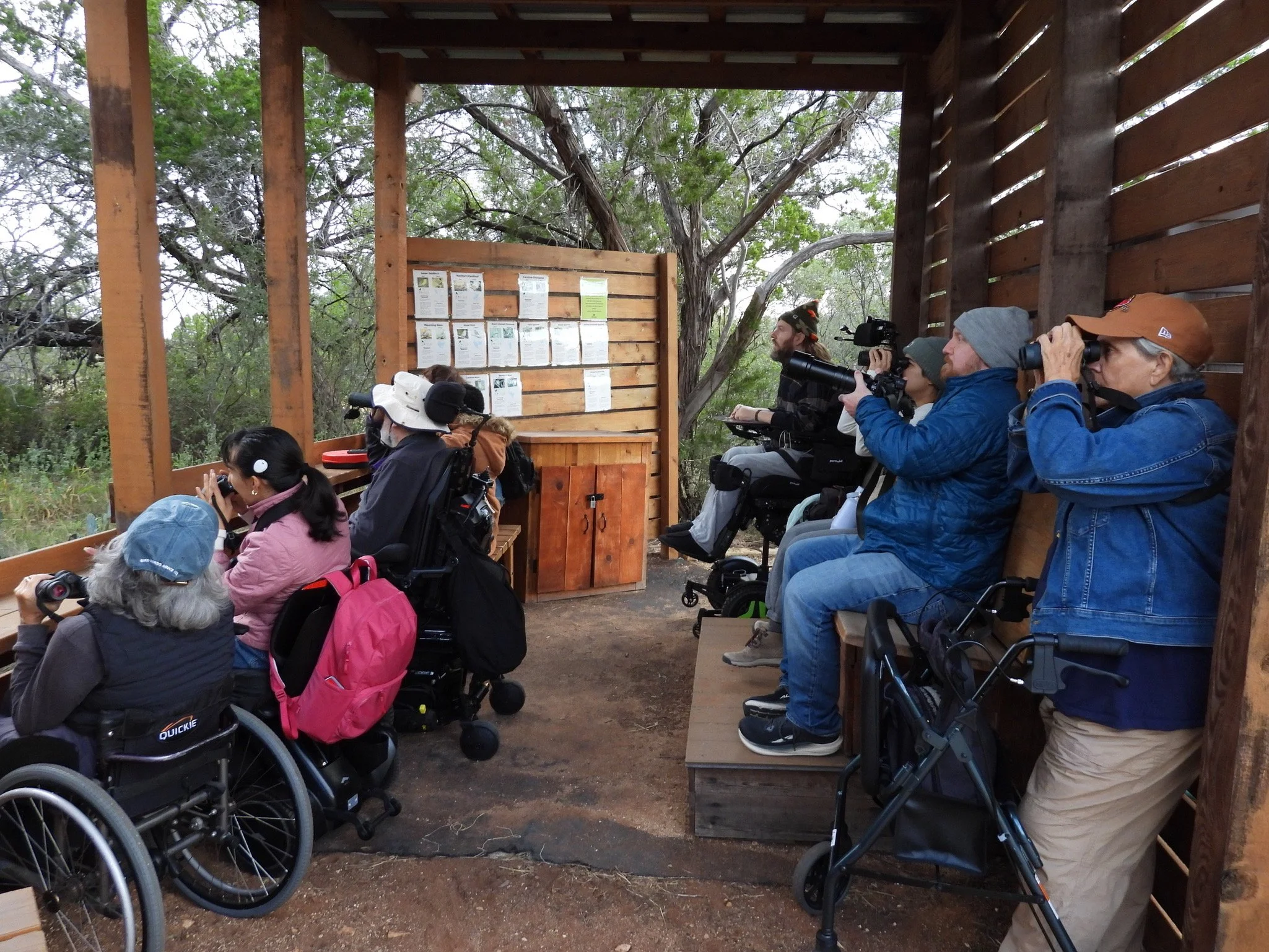
Image description: Birdability Captain and Founder Virginia Rose and Birdability Captain Eric Clow at a Birdability outing featuring a morning of accessible birding at the gorgeous Westcave Preserve accessible bird blind. Nine people, many using wheelchairs or other mobility devices(as well as binoculars and cameras), gather in a bird blind with a flat, accessible surface, with a high roof, some risers and benches for those who sit, and an open design for bird observation in the front. There is a wooden wall to the left with flyers and bird information posted on it.At Biosphere 2 in Arizona, people are gathering on the flat, stable Visitor Center patios for a Bird Sit, with feeders bringing wildlife close by and benches and tables available for participants. At Holliday Park in Indianapolis, stationary birding starts inside an accessible bird-viewing room, with the option to move outside if people want to. At Minnesota Valley National Wildlife Refuge, the Land of Lakes Bird Alliance and Birdability Captain Mark Paller is hosting a guided birding event specifically designed with people with mobility disabilities in mind. The bird feeder is about 400 feet from accessible parking along a wide, flat, paved route, with benches and chairs near the birding area. If the weather does not cooperate, the group will bird from the Visitor Center viewing window. And at the Albany Pine Bush Preserve in New York, one of the two newest additions to the map, birders will take a short stroll to a seating area and then stop to look and listen together.
None of those events asks people to cover miles to prove they went birding.
They start with a better question: Where are the birds, where can people comfortably be, and how can we bring the two together, which mirrors one of the quotes that really grabbed us last night on our first virtual event of Birdability Week 2026. While a whole community of birders with disabilities and chronic health concerns shared their approaches to self-care while birding, one participant, Ed, who runs a birding club for people with Long COVID, ME/CFS, and related conditions shared that they open every outing with: "We're here to protect your health and show you cool birds, but always in that order"
What if access changed the activity itself?
Some of my favorite events on this year's map are the ones that could only have been created when people started thinking beyond the traditional plans and approaches to the guided bird walk.
Montgomery Parks in Maryland is hosting Steal Their Look: A Birdy Fashion Show, where participants can choose a bird, recreate its look with everyday clothing and accessories, and strut down an accessible runway.
Feminist Bird Club Milwaukee and the Urban Ecology Center are hosting a Halloween Little Sit inspired by crows and their reputation for collecting small treasures. People can bring a trinket or treat, dress as a bird or not, sit together by the pond, and form their own murder of crows.
At Sweetwater Wetlands in Gainesville, Florida, Chronically Outside, a University of Florida student organization building community among students with chronic illnesses who love the outdoors, is hosting Bird Bingo along an accessible paved route.
In California, Pomona Valley Bird Alliance is turning a Birdability Site Review into the event itself, inviting participants to learn together about what makes a location accessible while doing some light birding along the way.
There is an owl prowl. There are bird sits, mindful birding programs, pontoon boat birding, birding by ear, nature journaling, adaptive equipment, bird banding, compostable bird feeders and even activities built around fashion.
This is one of the things I love most about accessibility. It helps make the definition of birding and the community surrounding it, bigger and more diverse.
What if we designed with particular communities, instead of assuming one event could work for everyone?

Image description: A group of blind birders, holding white canes and listening intently to birdsong in a local park with paved trails, participates in an outing organized in Venezuela during the 2025 Blind Birder Bird-a-Thon event.This year's map is also full of programs that begin by thinking intentionally about who organizers want to welcome.
In Illinois, a Birdability Week outing in Beecher is designed specifically for blind and visually impaired birders, centering birding by sound and creating opportunities to experience birds in ways that do not depend on sight. At the Cornell Lab of Ornithology, a program for blind and low-vision birders includes bird banding, specimens, sound-recording equipment, Merlin Sound ID, and a guided outdoor walk is happening. Other events across the map are also incorporating tactile and auditory approaches, from touchable feathers and nests to bird-call recordings and birding by ear, creating more ways for blind and low-vision participants to engage with birds on their own terms.
And that same thinking is showing up beyond the United States. Through BirdsCaribbean, partners across the Caribbean are exploring accessible birding approaches that include tactile carved birds for blind and low-vision participants and identifying birds through their songs, expanding the idea of what a birding experience can be and who gets to fully participate in it.
Birdability and Friends of Aphasia Tucson are gathering for a relaxed, open-house-style bird sit at Fort Lowell Park. People can come anytime during the two-hour window and stay for a few minutes or the entire event.
At Shepherd Center in Atlanta, they are hosting stationary birding with people connected to one of the country's leading rehabilitation hospitals, supported by our work of the Birdability Outreach Program, funded by the Craig H. Neilsen Foundation.
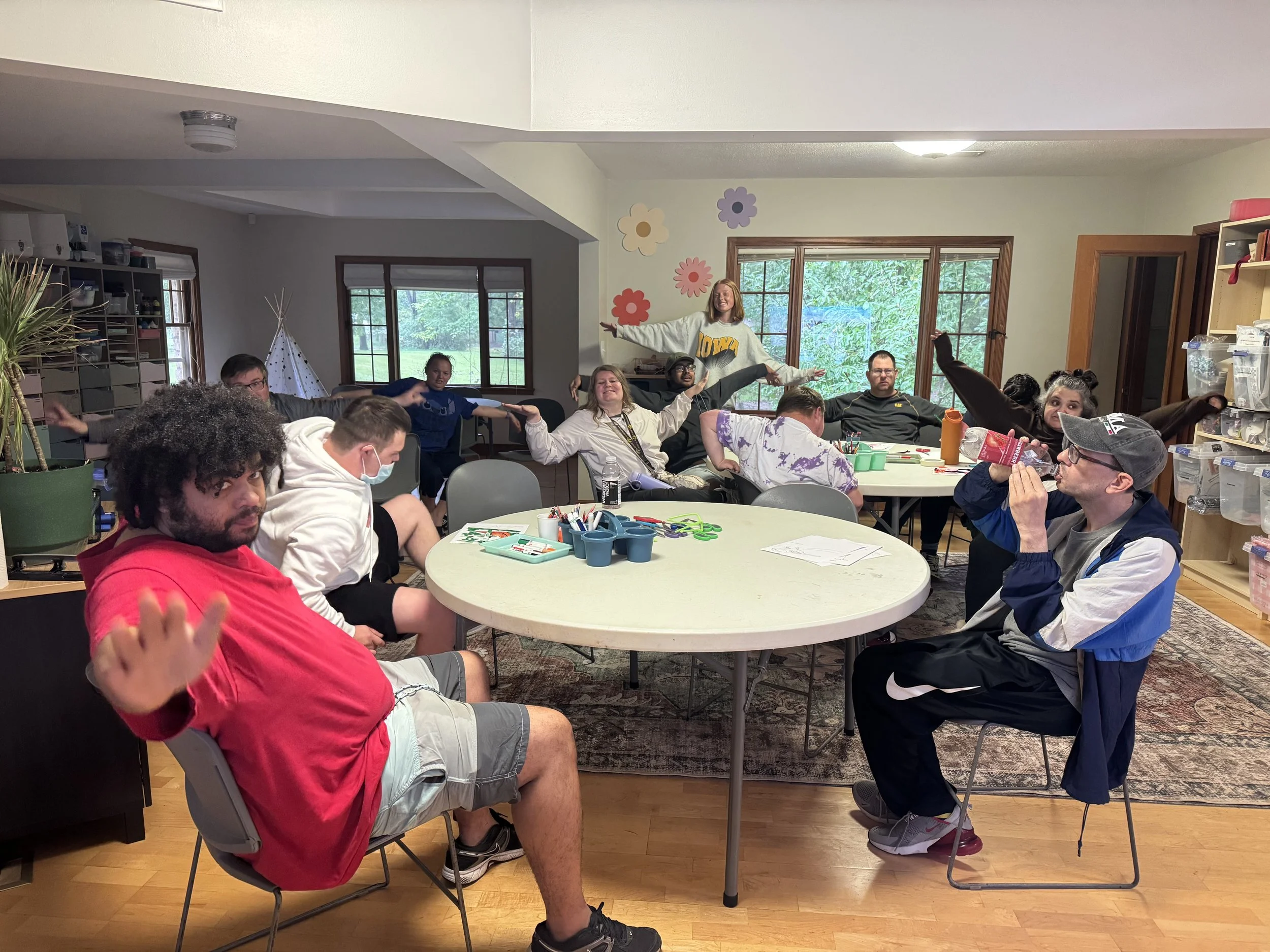
Image description: A group of young adults with cognitive disabilities gathers in a bright adaptive recreation room for a bird-themed program. Several participants are seated around tables with craft supplies, while others stand or sit behind them. Many are stretching their arms out like wings, smiling and participating in a 'what bird are you" activity.Laradon in Denver is bringing Birdability Week directly into its adult day program for people with intellectual and developmental disabilities with a “Lunch and Learn” about why watching birds is cool. Tucson Bird Alliance is hosting a Neurodiverse Birder Walk at Fort Lowell Park, intentionally creating space for neurodivergent birders to connect with others who may think, process, or socialize differently, in a location chosen for shade, seating, generally flat terrain, and wheelchair access. Saguaro National Park, Southern Arizona Adaptive Sports, and Birdability are also welcoming neurodivergent birders on an outing designed with a slow pace, scheduled rest breaks, shaded seating, loaner equipment, and a wheelchair-height spotting scope. And in Ohio, Upper Arlington Public Library’s Bird Roll and Walk specifically welcomes people with neurodivergent ways of understanding the world, with a slow-paced outing on a paved route with benches, indoor restrooms, and bird identification by both sound and sight.
Other events are building in sensory access even when neurodivergent birders are not the sole focus. John Bunker Sands Wetland Center in Texas is offering quiet zones and sensory-friendly options, including bird-call recordings and touchable feathers and nests, while the Feminist Bird Club Milwaukee and Urban Ecology Center Halloween Little Sit identifies a private quiet space that neurodivergent participants can use if they need a break from the group.
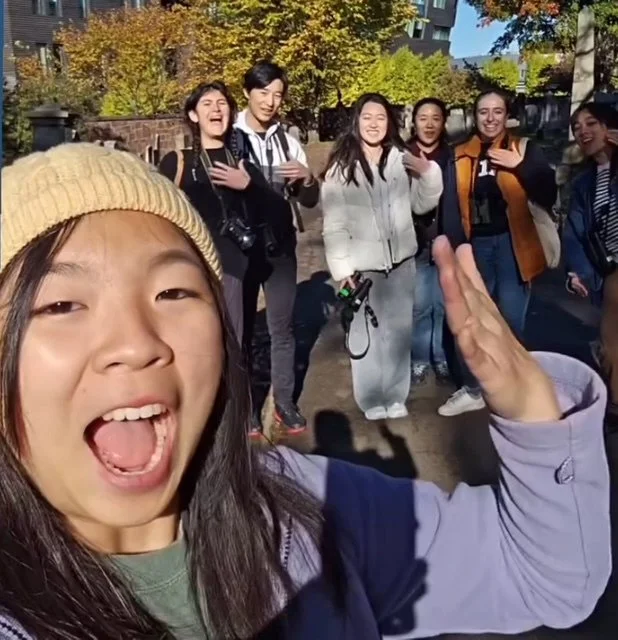
Image description: A young woman in a knit hat takes a joyful selfie outdoors during an ASL bird outing at Yale. She is smiling broadly and using ASL while a group of young adults stands behind her on a sunny walkway. Several people in the group are also signing, and some carry binoculars or cameras. Autumn trees and campus buildings are visible in the background.Montgomery Parks is offering a guided bird walk with ASL interpretation for d/Deaf and hard-of-hearing birders. As is North Branch Nature Center + Feminist Bird Club of Vermont who have ASL interpretation for both the guided bird walks and the stationary “Big Sit,” provided by Vancro Integrated Interpreter Services and donated by the Vermont Center for Independent Living. So does the Nature Center at Shaker Lakes event in Cleveland Ohio where Anna Henry and Julie West led a fully accessible bird walk on the ADA-accessible boardwalk with an ASL interpreter. And coming up on October 24th, Feminist Bird Club San Diego + San Diego Bird Alliance, Santee Lakes event will have a bird guide who is fluent in ASL, plus a sitting birding group.
And perhaps one of the most exciting additions to the map this year is happening in Phetchaburi, Thailand, where the School Beyond the Horizon, the National Association of the Deaf in Thailand and the Bird Conservation Society of Thailand are hosting their second birding event for d/Deaf and hard-of-hearing participants. Two Thai Sign Language interpreters will be there, and participants will practice with a newly developed Thai Sign Language application containing signs for common bird species.
Think about that for a moment. Be as joyfully delighted as I am at the ways that accessibility in birding can be so very different in Thailand, Tucson, Maryland, Minnesota or Maine. Communities already know a tremendous amount about themselves. Access grows when we listen to that disability-centered perspective!
And this is stretching far beyond the United States
There are Birdability Week events on the map in Canada and Thailand this year, alongside gatherings throughout the United States. And the international possibilities are growing in other ways, too.
A recent article from World Accessible Holidays called our theme, Bird Where You Are, one of the most interesting accessible travel ideas they had encountered this year. We are so grateful for their recognition that accessible nature experiences do not have to be watered-down versions of some supposedly more legitimate adventure. A bench, balcony, accessible viewpoint or well-designed short route can offer an extraordinary encounter with birds when the experience is built around flexibility rather than stamina.
The article also highlighted what is happening through our friends at BirdsCaribbean. Their partners in Antigua and Barbuda, the Dominican Republic, Puerto Rico, Cuba, St. Vincent and the Grenadines, and Margarita Island have been exploring ways to make birding experiences more welcoming and inclusive. BirdsCaribbean points to possibilities ranging from tactile carved birds for blind and low-vision participants to identifying birds through their songs, while encouraging communities across the Caribbean to add accessible birding locations to the Birdability Site Map.
I love thinking about Bird Where You Are moving across countries, cultures, languages and birding traditions, not as a program people have to copy, but as a question communities can answer for themselves: What does access look like here?
210 events. And 210 experiments in doing things differently.
Not every event on this map will be accessible to every disabled person. That is neither possible nor the standard we ask people to meet.
Some events are stationary. Some travel farther. Some are on pavement and some include natural surfaces. Some center mobility access. Others center d/Deaf birders, blind and low-vision birders, neurodivergent birders, people with aphasia, people with chronic illnesses or energy-limiting conditions, or people in rehabilitation settings.
Good access includes telling people those things clearly enough that they can decide what works for their own bodies and minds.
And this map shows something else I hope we carry far beyond Birdability Week.
We do not need one perfect model for accessible birding. We need hundreds of people willing to pay attention, listen, experiment, learn, describe access honestly and try again.
Right now, we apparently have at least 210 of them.
Bird Where You Are was never only about location but about starting with the person instead of the prescribed way of doing the activity.
And looking at 210 events across this map, I am so beyond excited to share with you all what becomes possible when we do just that!
Explore the Birdability Week map, find an event that works for you, or simply bird where you are. There is room for your way of being with birds here, too.
