
Holding a partly-accessible Christmas/Winter Bird Count
The Christmas/Winter Bird Count (CBC) is an annual community science effort to collect information about bird populations in your local area, held from December 14 to January 5 each year. It has been going for more than 120 years! Learn more about the Christmas Bird Count on the National Audubon website.
Birdability and the National Audubon Society have launched a new Christmas Bird Count Accessibility Toolkit, created to help CBC compilers, sector leaders, volunteers, and participants make their local counts more accessible and inclusive for birders with disabilities and other health concerns.
The toolkit grew directly from listening. Disabled birders shared their experiences through focus groups, CBC leaders shared strategies already working in their communities, and Birdability Captains and others with lived experience and expertise helped review the resources. The result is a practical collection grounded in what people actually need to participate.
The toolkit includes guidance on accessible planning and communication, multiple ways to participate through feeder watching, stationary birding, car birding, and flexible field routes, support for people with hidden disabilities and neurodivergence, templates for describing terrain and facilities, outreach and partnership strategies, quick wins, case studies, a planning timeline, and a field guide for inclusive leadership on Count Day.
We also recently hosted a webinar introducing the toolkit and talking through how different people can use it. One of the biggest messages was simple: you do not have to change everything at once. Start with one clearer route description, one additional participation option, or one new relationship with a local disability organization, and build from there.
Although these resources were created specifically for the Christmas Bird Count, much of the guidance can also support bird walks, bird-a-thons, community science projects, environmental education programs, volunteer events, and other outdoor programs.
Explore the toolkit at tinyurl.com/cbcaccess, and watch the webinar to learn more about putting these resources into practice.
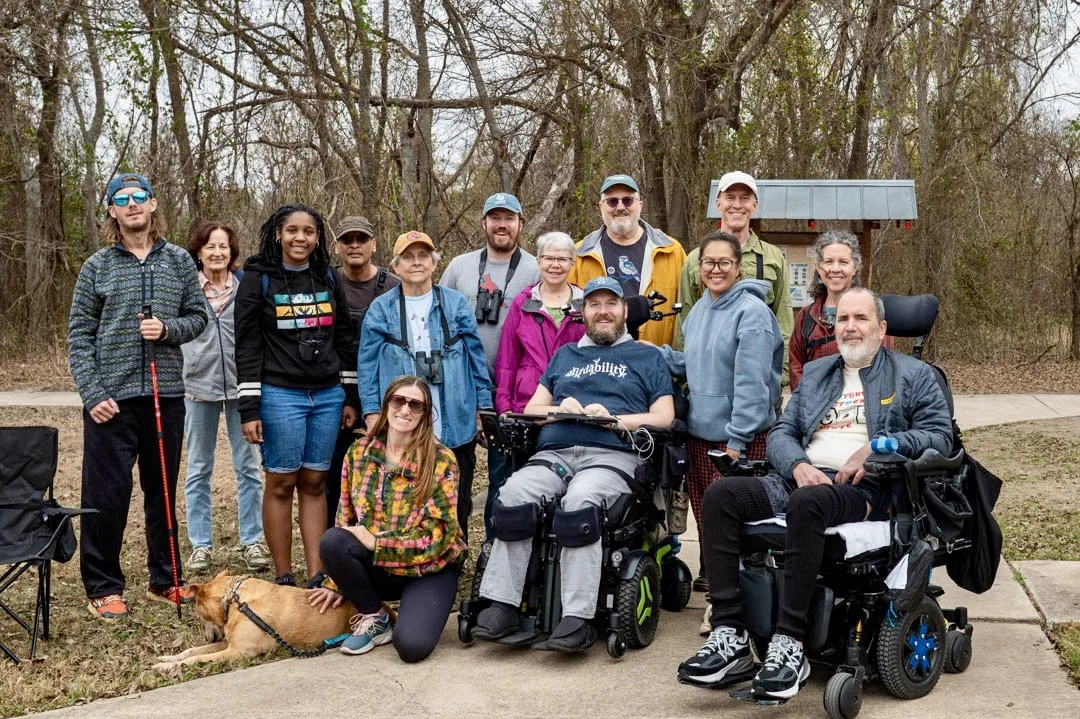
Image description: A group of 13 people gathered outdoors on and beside a paved trail in a wooded area. Several people are standing in the back row, while others are seated or kneeling in front. Two people use power wheelchairs, one person holds a white cane, and a service dog lies on the ground near the front. Several participants wear binoculars or other birding gear. The group is smiling toward the camera, with leafless trees and a trail information kiosk behind them.Quick start steps to implement a partly-accessible CBC in your area:
Step 1: Locate a CBC “circle” in your area which you’d like to be part of.
Step 2: Identify accessible birding locations within the boundaries of the circle.
Consider: car birding, parking lots overlooking water, fields, trees, etc., feeder watching, and accessible parks and trails.
You do not need to submit a site review to the Birdability Map, but it might be helpful to your participants.
Step 3: Reach out to the CBC circle compiler as far in advance as possible of count day and let them know you’d be interested in incorporating an accessible portion this year. Propose the sites you have identified, and/ or ask for further suggestions if those sites already get covered. Most counts have established systems and volunteers in place, but an accessible count can be a complementary effort. You could also ask if you would be welcome to join in with established groups for part of the time. If it will not work out with the first compiler you contact, remember that there are likely other circles nearby. Compiler contact information is available on the map of CBC circles.
Here’s an email template you’re welcome to use and edit if that’s helpful.
Often, compilers organize an event, known as a compilation gathering, at the end of the day for participants to come together, share sightings and have fun. We encourage you to ask the compiler if the location is accessible, and if not, consider volunteering to help locate a facility that will serve more people in the community. This may be a big ask, so consider getting involved and helping with this coordination in a future year if it’s not possible this year. An additional idea if the gathering location is inaccessible to you or someone in your group, is to ask if the compiler would be willing to include an online/video call component to the event for participants who cannot access the compilation venue.
Step 4: Reach out to your local disability community and invite folks to participate!
See Steps to Implement for ideas about local disability groups to connect with.
Be sure to include detailed accessibility information for each location. For information on what is important to include, see Writing bird outing event descriptions.
Reach out to us and we’re happy to provide social media and flyer templates!
Step 5 (Optional): Fill out the easy form below, so we can share about your partly-accessible CBC with others who may want to join in!
Step 6: Participate in the CBC! Count birds and take data! Your compiler will likely give you a specific data sheet to use. If not, use an eBird checklist and also take note of weather and temperature
Step 7: Enjoy the birds, and have fun! Please consider sharing your photos with us by tagging @birdability on social media! You are also welcome to share your photos with us by email.
Factors to consider when coordinating a partly-accessible CBC
How will your CBC be conducted?
Traveling on an accessible trail?
Sitting event? (Feederwatching can be part of the CBC as long as the location is within an established circle.)
Car birding?
Multiple locations or one site?
Combination of travelling, sitting and car birding?
Travel an accessible trail to a sitting location, sitting, travel back
Travel with sitting breaks along the way
Is there reliable public transportation to your location or between your locations? This may impact someone’s ability to participate.
Should you have a maximum group size? Is there enough interest to form multiple small groups?
Can you join the compilation gathering with others in the circle? (If this will not held in an accessible place, could you join via a video chat such as Zoom?)
Should you invite other groups in the circle to visit your site during their day?
The Christmas Bird Count is organized by National Audubon, with whom Birdability has a wonderful partnership. Audubon’s CBC partner in Canada is Birds Canada. Please direct any general CBC questions to your local compiler or to The National Audubon Christmas Bird Count program at cbcadmin@audubon.org.