Neurodivergent Birders and Birding Festivals
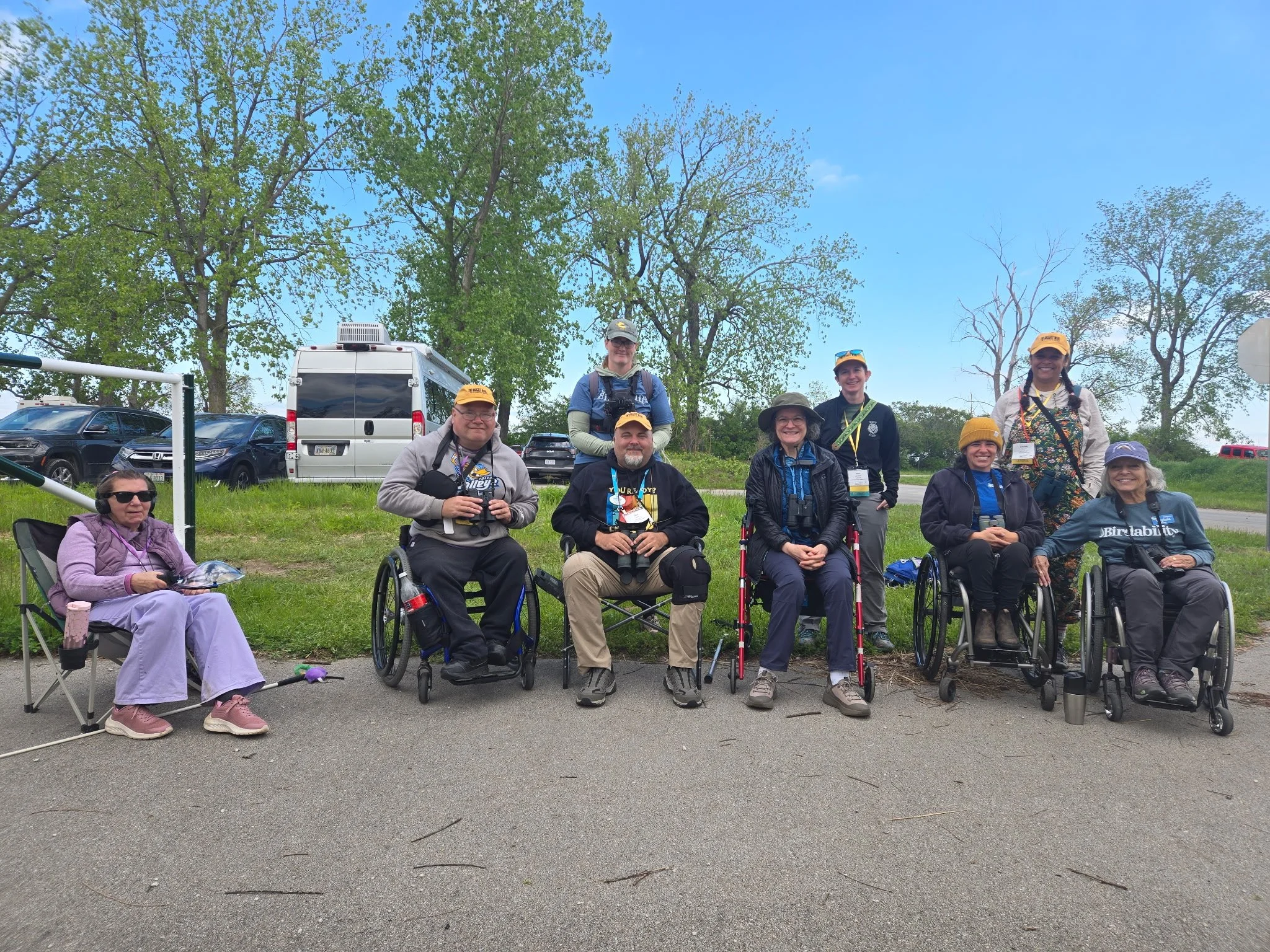
Image description: A group of nine birders and leaders gather along the edge of the road for an accessible stationary field trip at a birding festival. The participants and leaders in the front row of six people use a range of mobility and other adaptive/assistive devices including a white cane, multiple manual wheelchairs, a knee brace, and a walker. Behind them three other participants and leaders stand. All are dressed for cool weather and are smiling at the camera with newly leafing trees and parked cars behind them.Neurodivergent Birders and Birding Festivals: Findings on Accessibility and Inclusion is a Birdability resource grounded in the lived experiences of neurodivergent birders. Birdability gathered input through focus groups, individual interviews, and written responses to better understand what makes birding festivals and organized birding events more accessible, welcoming, or difficult to navigate. This report would not have been possible without the neurodivergent birders who generously shared their experiences, ideas, frustrations, and hopes with Birdability. We are deeply grateful for the time, thought, and trust each person brought to these conversations. It was developed in partnership with The Spark Bird Project, including funds from the Canisius University’s Autism and Aging Study (NIH Grant # R21 AG059051-01).
The report emphasizes that there is no single “neurodivergent experience” and no universal accommodation that will work for everyone. Instead, the findings point to the importance of choice, predictability, sensory accessibility, flexible participation, inclusive leadership, and involving neurodivergent people directly in planning and decision-making.
Its central message is a shift from accommodation to design. Rather than expecting neurodivergent birders to do the work of adapting themselves to inaccessible festivals, organizers can build access into how events are communicated, structured, led, and experienced from the beginning, with their expertise included along the way.
Findings on Accessibility and Inclusion In Brief:
Neurodivergent birders are already part of our birding festivals, outings, clubs, and communities.
But many organized birding experiences are still designed around assumptions about how people process information, navigate social situations, manage sensory input, communicate, move through a schedule, and participate in a group.
Birdability developed this resource, Neurodivergent Birders and Birding Festivals: Findings on Accessibility and Inclusion, to help festival organizers, bird clubs, outing leaders, and other community organizers think more intentionally about those experiences.
This resource is grounded in conversations with neurodivergent birders who shared what has helped them participate, what has created barriers, and what they hope birding events can become. Many thanks to each of the birders who shared their experiences and their time to help build this document.
It is not meant to be a checklist for creating a single kind of “neurodivergent accessible” event. Neurodivergent people have different, and sometimes conflicting, access needs. Many also live with multiple and intersecting disabilities and other health concerns. The goal is to create more choices, more flexibility, and more ways for people to participate.
What we heard
Accessibility begins before someone arrives
Uncertainty can itself be an access barrier.
Participants described how much difference it makes to know in advance what to expect, including information about parking, transportation, restrooms, terrain, seating, group size, timing, costs, food, sensory conditions, accommodations, quiet spaces, and who to contact with accessibility questions.
Clear headings, plain language, maps, FAQs, and detailed event descriptions can help people prepare, conserve energy, and decide what will work for them.
Clear, detailed information is an accessibility tool.
Sensory access matters hugely
Noise, crowds, overlapping conversations, artificial lighting, enclosed spaces, and unexpected environmental sounds can affect someone's ability to process information, communicate, bird, or continue participating.
Sensory overload may also have effects long after someone leaves the immediate environment.
Thoughtful sensory planning can include quieter gathering options, awareness of noise and lighting, intentional scheduling, sensory tools, and clearly identified quiet spaces close to the main event.
A useful quiet or sensory space should be easy to find, physically accessible, close enough to festival activities to be practical, and available without requiring someone to explain or justify why they need it. It should also be clear about the purpose and whenever possible have either staffing nearby, or a way to reach a festival staff person.
Social accessibility deserves attention too
For some participants, birding itself was much easier than navigating the social expectations surrounding birding.
Networking events, cocktail hours, small talk, and unstructured gatherings can leave people wanting connection without knowing how to enter the conversation.
Structured opportunities such as facilitated introductions, bird-related activities, conversation prompts, small affinity gatherings, creative activities, or hosts who intentionally welcome people into conversations can make connection easier. It may also be useful to create affinity spaces for neurodivergent festival-goers to be able to opt-in to socializing with other people experiencing similar access needs or concerns.
Smaller, slower, and stationary birding can open more doors
Participants described the value of smaller groups, slower outings, stationary birding, shorter programs, multiple start times, built-in breaks, and different ways of participating in birding field trips or outings.
Stationary birding in particular can reduce transitions and physical demand while increasing opportunities for seating, communication, sensory predictability, and community-building.
Access needs do not exist in separate boxes
Neurodivergent birders may also have mobility disabilities, chronic illnesses, energy-limiting conditions, sensory disabilities, or other access needs.
An experience that works well in one area may still create barriers somewhere else.
Accessible planning should consider the whole person and offer enough options that participants are not forced to choose which access need is accommodated.
Culture and leadership matter
And accessibility is not only about infrastructure.
Participants described the effects of gatekeeping, competition, dismissiveness, assumptions about knowledge, and the idea that there is one “right” way to bird.
In contrast, people felt welcomed when leaders valued common birds as well as rarities, encouraged questions, noticed people at the back of the group, communicated clearly, respected different ways of observing birds, and intervened when someone was treated poorly.
Inclusive trip leadership is an accessibility skill that can be learned and practiced.
Neurodivergent people should help design the solutions
One of the clearest messages from participants was simple: include neurodivergent people in the work.
Neurodivergent birders can help review websites, evaluate sensory environments, design field trips, train leaders, plan social opportunities, identify accommodations, and assess what worked and what did not.
They should also be present throughout birding communities as speakers, trip leaders, volunteers, planners, advisors, teachers, and experts.
As the report notes, the strongest accessibility planning happens with neurodivergent people, not simply for them.
Moving from accommodation to design
Many neurodivergent birders arrive at festivals already prepared to create access for themselves. They research parking, bring sensory tools, search for quiet places, prepare for unclear schedules, manage social expectations, and decide which parts of an event they can realistically attend.
We can ask something different of our festivals and birding communities.
Instead of helping people become better at navigating inaccessible events, we can design better events.
That means clearer information. More choices. Quieter spaces. Smaller and slower outings. Flexible schedules. Thoughtful leadership. Multiple ways to participate. And real relationships with neurodivergent birders.
Many of these practices will also benefit first-time participants, older adults, families, people with disabilities and other health concerns, people experiencing anxiety, and many others.
But their broad usefulness should not obscure why this work matters specifically for neurodivergent birders.
There may be people who are not currently attending our festivals or joining our bird clubs because the environments do not yet feel accessible or welcoming. They may never appear on an accommodation request form because they never register in the first place.
So the question is not only, “How do we accommodate the people who are here?” but also, “Who is missing, why are they missing, and what needs to change so they can participate?”