
Turning to Birds, Together
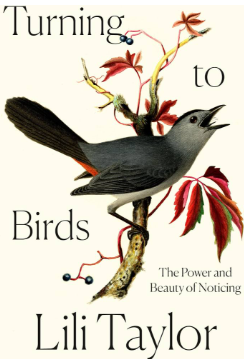
Image description: The cover of the hardback copy of Lili Taylor's Turning to Birds: The Power and Beauty of Noticing with a Grey Catbird, mouth open, perched on a branch with red and green leaves, and a few berries on a vine. When I first wrote a review about Turning to Birds: The Power and Beauty of Noticing, for our state ornithological union’s newsletter, I kept returning to a moment at The Biggest Week in American Birding back in May that I also shared last night at our Birdability Book Club discussion. I had seen the author and actress moving around the festival as I tabled for Birdability, then later that week, I saw her on the Magee Marsh boardwalk, binoculars up, looking into the trees with everyone else. I loved that moment so much. Despite her fame, she really was just another birder hoping for a chance to get a good look at a warbler.
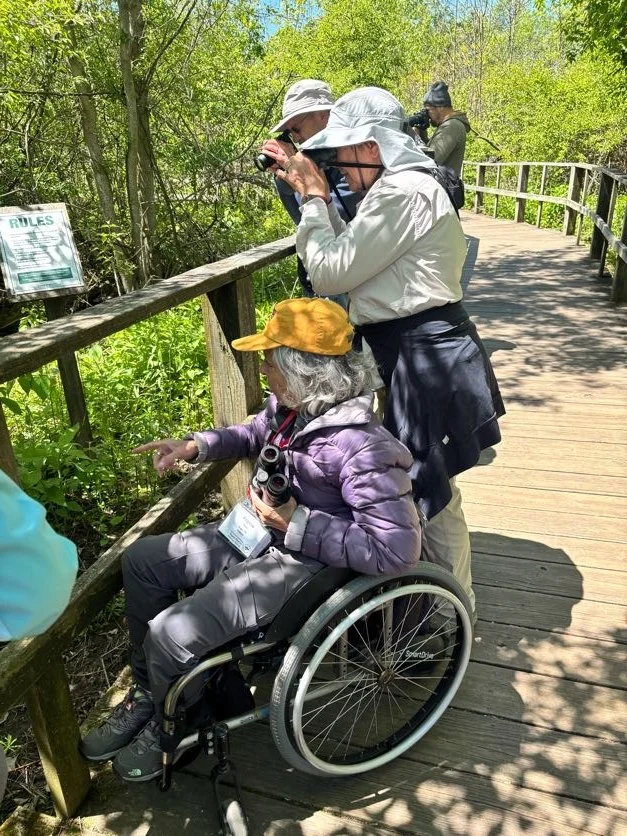
Image description, Birdability founder, Virginia Rose, sitting in her manual wheelchair wearing a purple puffy coat and a BWIAB Guide cap while holding a pair of binoculars and pointing at a bird just off the Magee Marsh boardwalk, while surrounded by other birders with their binoculars up looking in the same direction. Photo courtesy of Peggy Rose. That feeling runs through the book. This is not a book about her (or anyone else) becoming the “best” birder. It is ,though, deeply about what happens when we begin to notice the living world around us more closely, and how birds can reshape a life. The essays move between birding trips, city walks, theater work, travel, memory, relationships, and the everyday practice of looking and listening to birds.
After discussing the book last night with the folks attending the Birdability Book Club, I understood even more clearly that noticing is not a skill reserved for people with particular knowledge, bodies, abilities, senses, or resources.
One person joined us after making it only a few pages into the book. Their body and brain were not cooperating that day, and reading simply was not working. We talked about how books sometimes find us at the right moment, and sometimes they do not. There was no expectation that anyone had to finish the book, understand every passage, or participate in a particular way. People joined after reading in print or Braille, listening to the audiobook, reading only part of the book, or simply coming to hear what others had to say.
That, too, is a practice. A practice that asks us to pay attention to our own capacity, trust that there is still a place for us in the conversation, and honor our needs above all else.
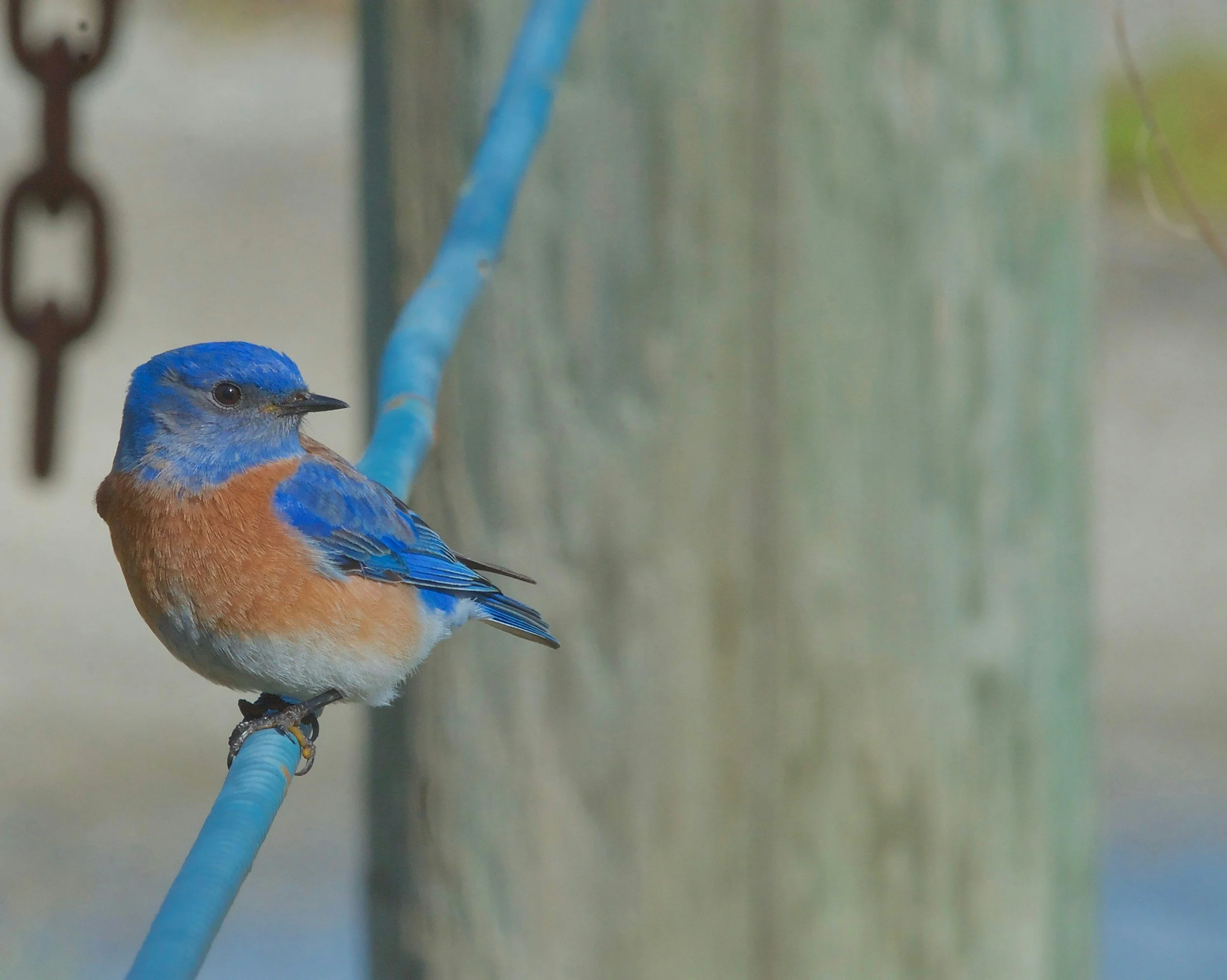
Image description: A Western Bluebird perched on a blue metal railing. The bird's bright blue hood and back are in contrast to the rusty chest and white underbelly. Photo courtesy of v_I_n on Unsplash. Our discussion kept turning to the many places and ways birding happens. Someone spoke about listening to Western Bluebirds from a balcony while reading the chapter about bluebirds in Braille. Another participant shared a story about encountering Sandhill Cranes while working in a front yard just after reading the chapter on Sandhill Cranes. We heard about Chimney Swifts gathering over a neighborhood school (and later found out that two of the participants had BOTH been in the audience for that spectacular event), Snow Geese rising together from a field, and a wildlife drive where people can experience birds without leaving their vehicles.
Some of us have crossed the country to witness the annual crane migration in Nebraska, just as the author described. Others shared about meeting birds from bed, through a window, in a garden, from a car, or while waiting on a city sidewalk. Noticing absolutely does not depend on money or travel, or a particular kind of body or ability. We can bird exactly where we are. (Birdability Week 2026 has the theme Bird Where You Are, and it seems so relevant everywhere I turn!)
The conversation last night also reminded me that attention does not always mean shutting everything else out. At times it may even mean allowing ourselves to be wonderfully distracted. At my house, we take a lot of what we call 'bird breaks'. Whatever we are doing may stop because a bird has arrived at the feeder or called from the backyard. Deep attention can mean being willing to interrupt the task in front of us and receive the moment that has appeared.
The book’s rich descriptions opened other kinds of access. Blind readers in our conversation described being able to enter scenes through the author’s language. As someone with aphantasia and no mind’s eye, I also found that her writing sometimes brought me closer to imagining a scene than I usually can. Her descriptions of birds caught in the memorial light beams in New York City helped several of us understand both the danger and the careful human effort required to protect them. Her account of cranes lifting from the Platte River gave language to an experience people described as almost supernatural, even though it is completely natural.
One of the words from the book that stayed with our group was “numinous.” It names that feeling of being in the presence of something larger than ourselves. Many of us recognized it immediately. We identified it as happening among hundreds of thousands of cranes, certainly, but it can also happen with a single bird outside our home. And regularly does!
The conversation uplifting the writing did not require us to appreciate every part of the book. One passage about killing House Sparrows to protect bluebirds felt deeply jarring to some of us within a book that is otherwise so contemplative. It was an enlightening opportunity to talk about natural predation, childhood memories, guilt, and the complicated choices people make in their relationships with birds. Paying attention also means noticing (and talking about) what unsettles us rather than smoothing it over quickly to stop the ache.
One of the things I loved most about both the book and our conversation at book club was how relational they both were. These essays by Lili Taylor are filled with other people! Curiosity moves from one person to another as e shared our experiences of the book. The author describes how a birder looks up, and another person wonders what they are seeing and stops to ask - an experience that many of us have been on both sides of in this group. Someone shares an accessible birding location or boat trip, and suddenly another person can imagine partaking in an experience they had assumed was unavailable to them. Someone else describes what a bird meant during a painful period, and others recognize their own lives in that story (a particularly common reflection here at Birdability).
Birds are companions, anchors, teachers, and points of connection. They orient us to season and place and may also help us move through grief, isolation, pain, uncertainty, and change. They can also bring us into community with people we might never have met otherwise, and introduce themselves to new fans through an actress with her own brand of fame.
At one point in the book, the author writes, “And at the end of the day, that’s all we have: a life of moments, assembled as one.”
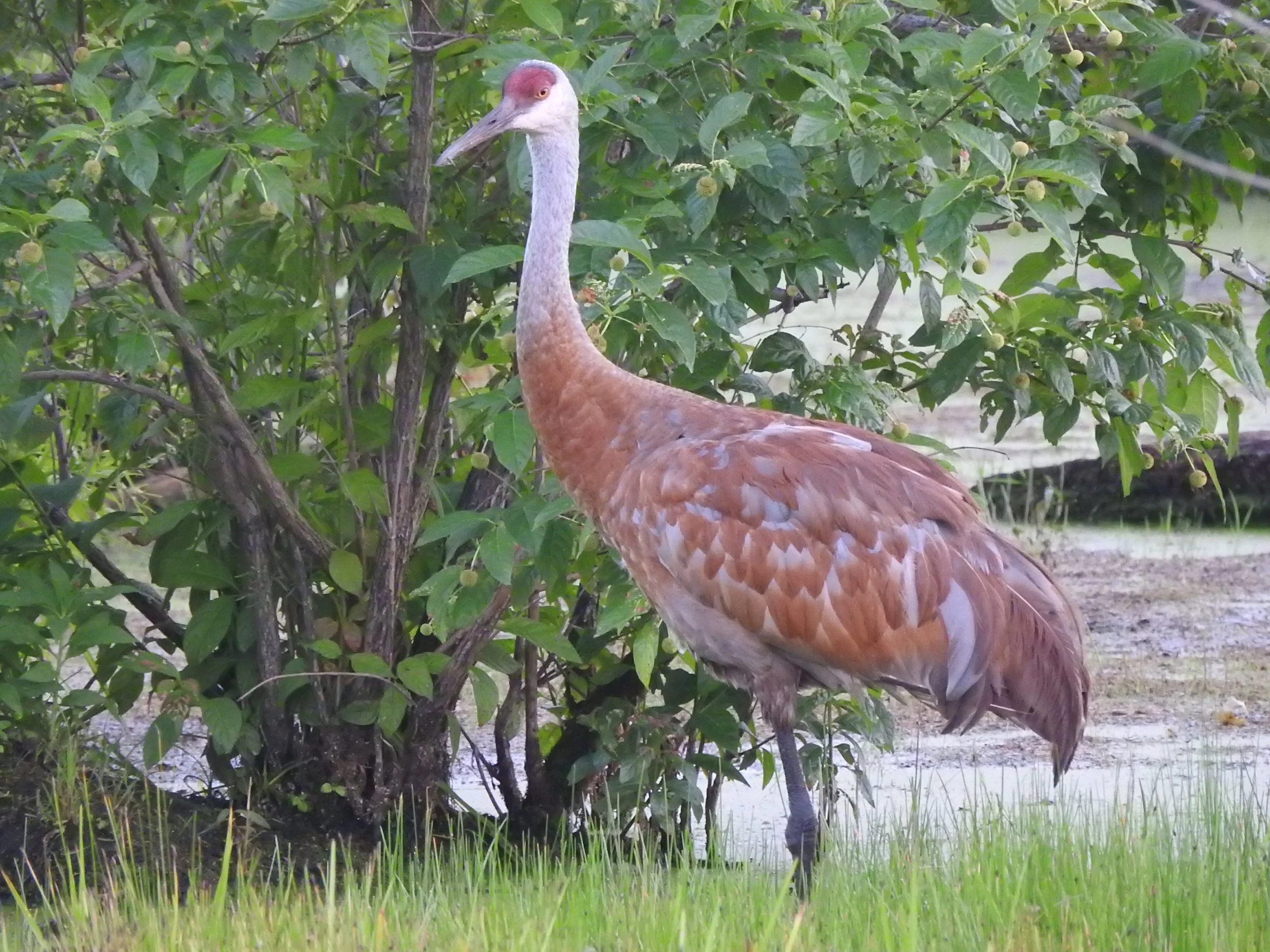
image description: An adult Sandhill Crane, grey body with intense rusty staining across it, with a red crown and bright yellow eye. The bird is in a suburban neighborhood, walking between a house and a lake along a road in Michigan. Photo courtesy of the author, Executive Director Cat Fribley.Our conversation felt beautifully like an assembly of moments as we closed the call. We had discussed a catbird returning to an Iowa backyard. Bluebirds outside a balcony. Cranes walking down a neighborhood sidewalk. Swifts circling a school chimney. A Woodcock dancing at the edge of a field. A bird heard but not yet identified. And there we were, a gathering of people from many places, with different disabilities, experiences, and ways of reading and birding, listening closely to one another and paying deep attention to each other's thoughts and feelings. Part of the “power and beauty of noticing”.
