When Language IS the Accessibility Feature
Image description: Scrabble tiles laid out in a grid that says, "Choose Your Words". Image courtesy of Brett Jordan via UnsplashWe have been talking a lot about inclusive language around here these last few weeks. With our Captains’ Community, and on a webinar with Audubon Chapters, as well as with ornithology students, and in a workshop for community members from Maryland who are interested in joining the movement advocating for more accessible birding and nature programming.
Birdability began with the knowledge that birding and access to nature are powerful. They offer joy, connection, and a way back to ourselves. And yet, for many people with disabilities and other health concerns, that experience has often been out of reach because of the barriers around them.
We exist to change that.
Birdability is a nonprofit working to make birding and the outdoors accessible and inclusive for everyone, especially those with disabilities and health concerns. We work at the intersection of disability, conservation, and community to ensure that access and belonging are the foundation of outdoor experiences.
Our work began with Birdability Founder Virginia Rose, who recognized that the barriers she faced in birding were not inevitable, and set out to change them. You can learn more about how Birdability came to be at https://www.youtube.com/watch?v=ABUxlnAdubE

Image description: Virginia Rose and Travis Audubon ED, Mashariki Cannon, talk at a Birdability + Travis Audubon event, in April 2024. Virginia is using a manual wheelchair and Mahariki stands beside her, gesturing as she talks. Father down the trail are a man using a walker and a gait belt with a recreational therapist, and a person in a green shrt with binoculars around their neck. Photo by Mike Fernandez, National Audubon. Some barriers are easy to identify.
A trail that is too steep. A path that ends in stairs. A lack of seating, or shade, or a place to rest. No ASL interpretation. These are the kinds of barriers we are often trained to notice. They shape who can physically be present in a space, and whether birding feels possible at all.
But other barriers show up much earlier, and play a part in whether a space or a program or an outing feels accessible to many folks with disabilities and other health concerns. Those barriers may live in the words we use to describe an experience.
You come across an event that is labeled “accessible,” but nothing more is said. No mention of the trail surface, or how far you might travel, or whether there will be places to sit. No indication of whether birding will happen from a fixed location or whether the group will be moving the entire time. Whether there are bathrooms or a water source. For someone with a disability or other health concern, that lack of detail is often a barrier. It requires participants to fill in the gaps, to imagine best and worst case scenarios, and to decide whether it is worth the uncertainty to try and attend.
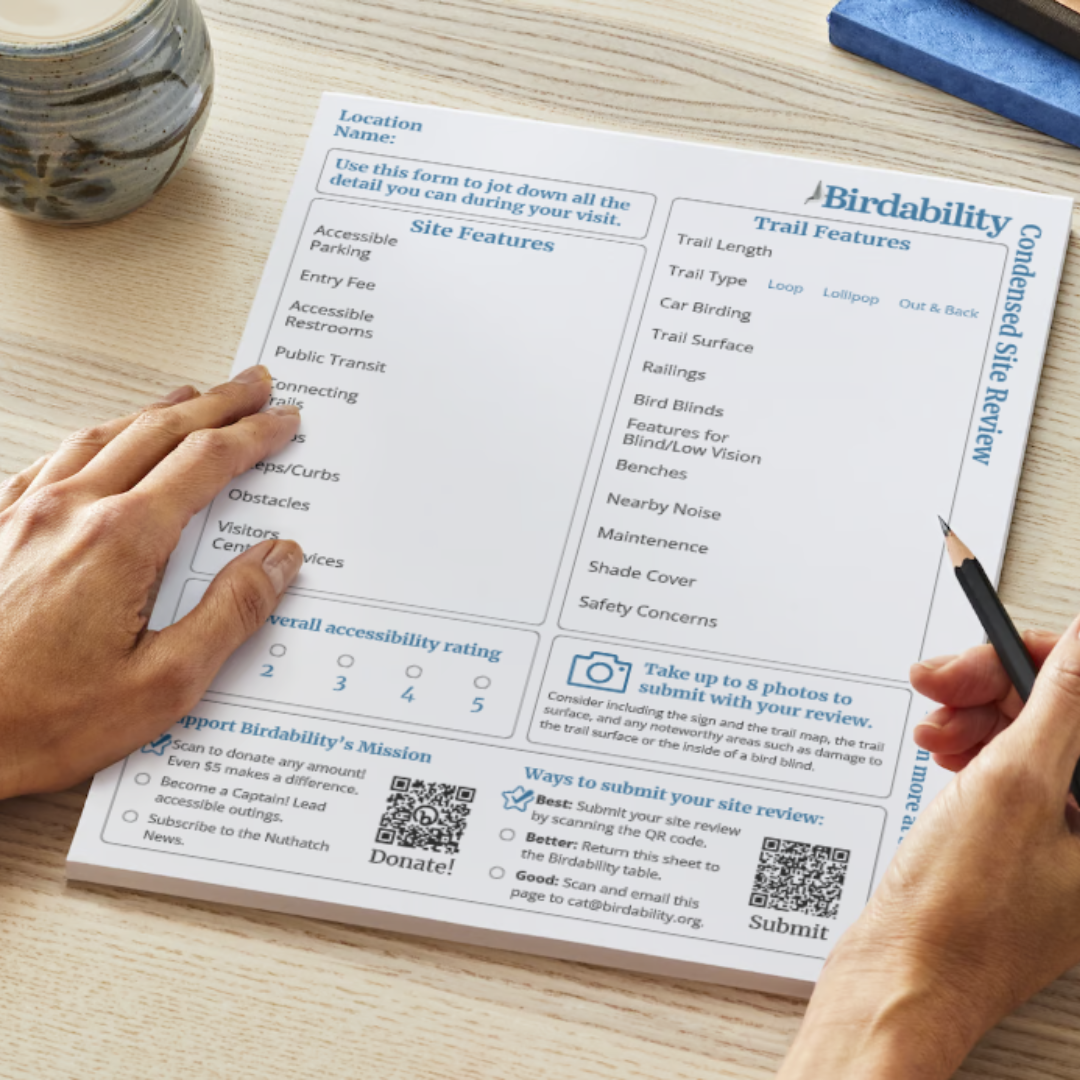
Image description: A photo of a printed site review form for the Birdability Map. There are hands on either side, with a pencil grasped in the right one. The form has questions about access, such as trail length, bathroom specifics, shade cover, benches present, whether there is public transit to the site, and more. For the whole list, you can find a downloadable document here. This is part of where language becomes part of accessibility. It is a practical and immediate way to shift how we make people feel welcome, and provide enough detail to allow people to determine accessibility FOR THEMSELVES. Language is how we share information and how we signal who is invited. It is how someone begins to understand whether they can be part of what we are offering. When websites, outing descriptions, social media posts, and more are specific, when we describe what access actually means in that specific circumstance or location, we reduce that uncertainty. We make it easier for someone with a disability or health concern to say yes, because they know what to expect and whether that fits for their body/mind/energy that day.
At the same time, language shapes more than logistics; it also shapes belonging. It reflects the assumptions we carry about who birding is for and what it is supposed to look like. When we use phrases like “bird walk,” we may not intend to exclude, but we are still centering a particular way of moving through the world. When we talk about “real birding,” we can unintentionally narrow the definition of what counts, and exclude folks who don’t feel they fit that concept. But we know that birding has always been broad enough to welcome anyone interested. We define birding as anytime someone enjoys wild birds - and it happens from backyards and balconies, from cars and mobility devices, from hospital windows, and through listening as much as through looking. Expanding our language helps us reflect that reality, and in doing so, helps more people identify themselves in it.
Language also makes people feel respected and welcome, or can create distance in ways that are just as real as any physical barrier. The words we use to talk about disability carry history, assumptions, and values, and people with disabilities notice them right away. Terms like “confined to a wheelchair” or “the handicapped” can signal limitation or otherness, even when that is not the intent. More thoughtful language, like “wheelchair user” or “birders with disabilities,” reflects people as whole and active participants in their own lives. These shifts may seem small, but they shape how someone feels in a space.
It is natural, in conversations like this, to want clarity. To want a set of correct terms that can be learned and applied. But language around disability does not work that way. As Birdability Captain Eric Clow reflects, there is no single right language, because there is no single disability experience. The words people use are shaped by identity, culture, preference, and context, and they may shift over time. What matters is not memorizing a list, but paying attention to the people in front of us. Listening when someone shares how they identify and being willing to adjust and to learn from them about their own preferences and identities.
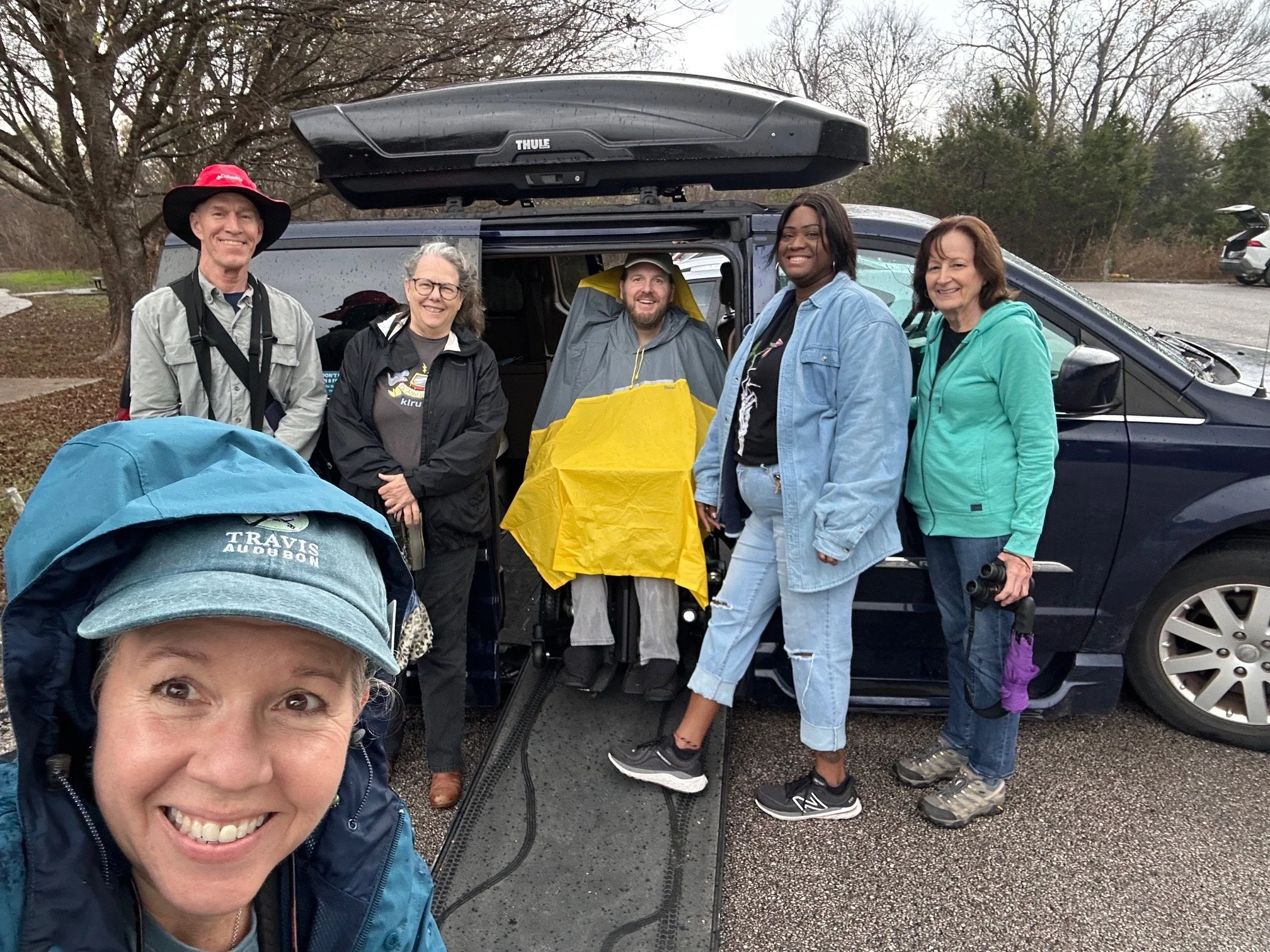
Image description: Eric Clow sits in his power wheelchair covered with a yellow and grey rain poncho at the top of the ramp to his accessible van as it sprinkles rain. His wheelchair left a pair of wet tracks up the surface of the ramp that are viible along with individual raindrops. Around him are five other folks who participated in a Birdability and Travis Audubon accessible CBC outing in Autin, TX. This also means recognizing that we will not always get it right. Language is deeply ingrained, and many of us have learned ways of speaking that we are now being asked to reconsider. Moments of misstep are inevitable. What matters is how we respond to them. Within Birdability, we often return to a simple approach that allows us to stay grounded in those moments: acknowledge what was said, offer a broader or more inclusive way to frame it, and then continue forward together. A new volunteer Birdability Captain who took part in a conversation about this work shared, “ It is so helpful and freeing to stop avoiding some conversations because I am scared of using the wrong language.”
One of the most meaningful shifts we can make is to move away from trying to categorize people and toward understanding what support looks like in practice. Rather than focusing on labels, we can each begin by asking what would help someone participate more fully. That question, simple as it is, opens a different kind of conversation. It acknowledges that access needs are varied, often invisible, and sometimes changing from day to day and minute to minute. It also places the focus where it belongs: on making the experience itself more accessible, rather than on defining the person.
Inclusive language, then, is not about perfection or saying exactly the right thing at all times. It is about building a practice of care and attention that shows up in the way we communicate, the way we describe our events, and the way we respond to one another. It is one of the ways we make it clear, long before someone arrives, that they are part of our vibrant and diverse birding community.
