
Martha Steele on the Blind Birder Bird-a-Thon
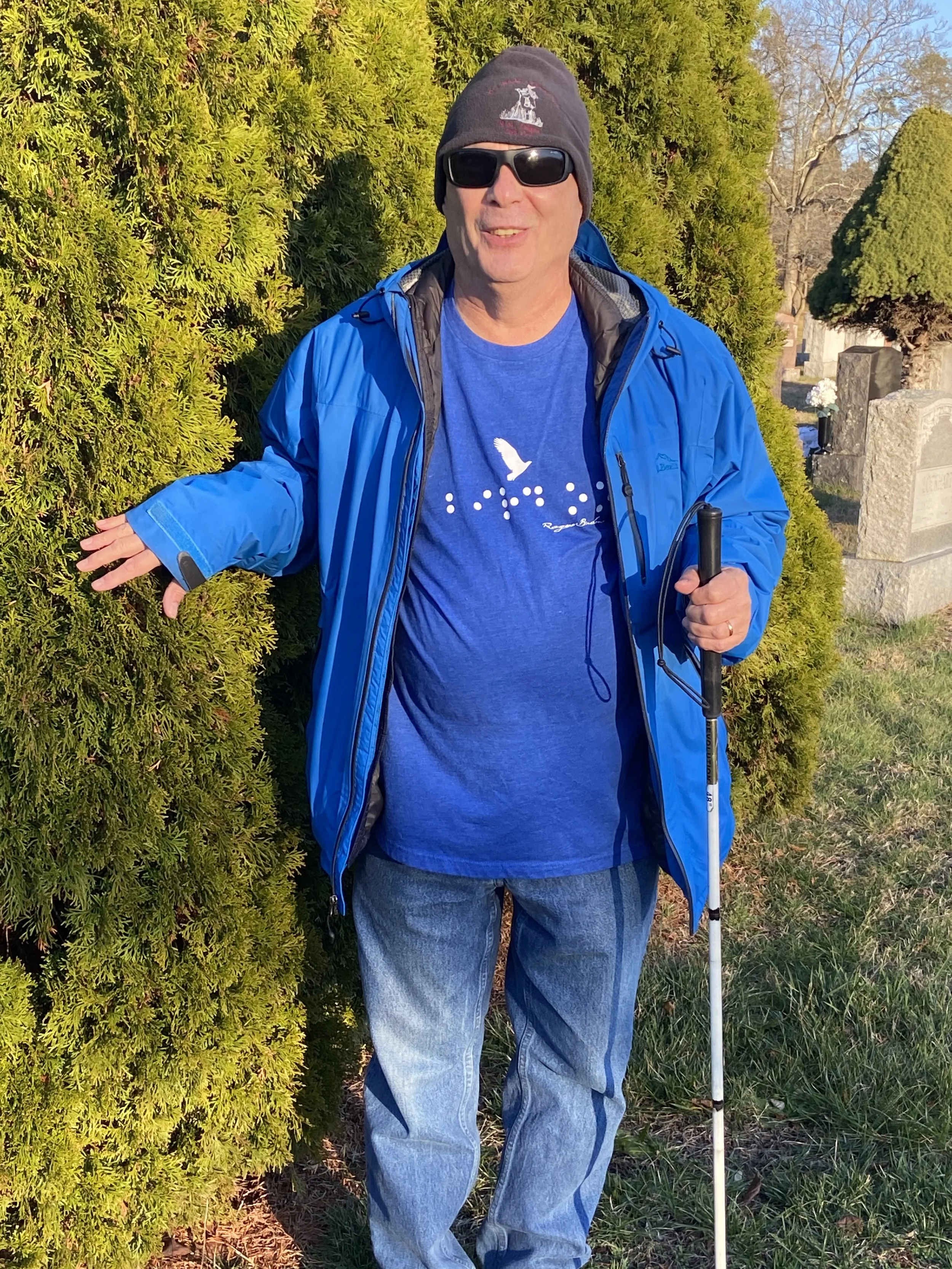
Image description: Jerry Berrier stands outdoors on a sunny day beside a dense evergreen shrub or small tree. Attired like any other birder, he wears jeans and a knit cap. And the instant giveaway: He is wearing a bird shirt with prominent Braille type. He is smiling and using a white cane. He is in a setting with soft light, at the edge of a grassy area in a cemetery.This article, Seeing Further: Blind Birders Advance New Frontiers of Learning and Discovery is reprinted with permission from the birding in the 2020s issue of the ABA Magazine, Birding. Many thanks to the ABA and Ted Floyd, Birding Editor. Click here for a fully formatted version of the article.
Visually impaired birders, historically excluded from mainstream birding, launch a successful global bird-a-thon.
On May 18, 2025, the first-ever national Blind Birder Bird-a-Thon took place in 34 states, Washington, D.C., and Puerto Rico, as well as Canada and Venezuela. Species recorded included everything from fluting Wood Thrushes to squeaky Bananaquits to whistling Venezuelan Troupials. This event was a signature moment to draw people who are blind or partially sighted to the outdoors and give new meaning to the word birdwatching—that birding is not only about the kaleidoscope of colors seen through binoculars but also an auditory adventure of discovery guided by sound rather than sight.
I was one of those blind birders. I have Usher syndrome, an inherited retinal disease that causes progressive hearing and sight loss, the latter due to retinitis pigmentosa (RP). RP typically starts with loss of night vision followed by an increasingly narrow peripheral field and finally loss of central vision. I was diagnosed with hearing loss as a young child and began wearing hearing aids. My RP was not diagnosed until I was a young adult. Although I went on many wilderness hiking and camping trips in the 1970s and 1980s, I never paid attention to birds other than the Common Loon while canoe camping in Minnesota’s Boundary Waters Canoe Area Wilderness and Algonquin Provincial Park in Ontario. I did not realize I couldn’t hear birds other than a few species with low pitches, such as the loon and the Mourning Dove, and, hence, I was usually not aware of their presence.
I started birding in May 1989, when I joined my work friend, Martha Vaughan, at a morning walk she led for company employees at Mount Auburn Cemetery in Cambridge, Massachusetts. I showed up without binoculars, but Martha had an extra pair. She led us through the front gates and immediately raised her arm to the sky and exclaimed, “A parula!” I didn’t hear the Northern Parula nor any other bird, only her and other birders’ excitement at all of the songs filling the early morning air. However, I saw warblers—lots and lots of warblers—and I was hooked.
At the time, I was a sighted birder unable to hear birds. By 2009, my central vision was beginning its nosedive, which in turn affected my speech understanding that was buttressed throughout my life by reading lips I could no longer see. To address my declining speech understanding, I received a cochlear implant in 2010. The device was a spectacular success, significantly improving my ability to understand people, primarily because I heard for the first time the high pitches of some consonants. It also had an entirely unexpected outcome.
When my husband, Bob Stymeist, and I walked out of the hospital in downtown Boston with my new device, monotonous strings of cheep and chirp sounds reached me. “Bob, what is that?”
“House Sparrows,” Bob replied, unable to suppress his excitement.
We both stopped and stared at each other, mouths agape with ever-expanding smiles.
“Oh my God, I hear them! I hear the birds! But I have to admit, these guys aren’t charismatic with their songs, almost annoying, really.”
That I heard House Sparrows on that first morning meant I would hear other birds for the first time. I was about to embark on a thrilling journey of learning bird songs that would rejuvenate my birding avocation precisely at the time I was about to lose my ability to see them.
Several years ago, I met a local birder, Jerry Berrier, the first person I knew who was a serious birder and blind. And for a while longer, I would go on to meet only one other birder who was blind. So when I saw a Washington Post article in Oct. 2024 featuring a Michigan birder who was blind and leading birding and nature walks, I asked myself, “How many of us are out there?” I thought one way to find out was to hold a national Blind Birder Bird-a-Thon that would not only help identify other birders who were blind but also encourage anyone who is blind or partially sighted to get outdoors and bird.
I called Jerry, and he agreed enthusiastically that this was a great idea. He knew the Michigan birder, Donna Posont, and recommended that we contact a nonprofit organization, Birdability, to help us organize the event. Cat Fribley, Executive Director of Birdability, immediately endorsed her organization’s involvement, and it was off to the races.
Our goal was to encourage legally blind individuals of all ages from across the U.S. to go outdoors in their local area and bird regardless of their level of expertise in identifying birds. We sought to dispel the notion that just because you can’t see well, you can’t bird. And we sought to open up the natural world to people who historically have been excluded from it.
To participate in this inaugural Blind Birder Bird-a-Thon, a person had to be legally blind. Many people believe being “blind” means your world is completely dark. But according to the American Foundation for the Blind, only about 15% of those classified medically or legally as blind fall into the total blindness category. This is why we use the term “partial sight” or “low vision,” as most people with uncorrectable sight loss still have some functional sight.
The parameters of blindness are vast. In the case of RP, we endure constant incremental peripheral and central vision loss over decades, meaning that the parameters of our sight loss are constantly changing. Our night vision is gradually worsening, our peripheral field slowly narrowing, and visual acuity finally declining, requiring never-ending adjustments from year to year or even month to month.
Legal blindness particularly confuses people because it exists at the tricky intersection of medicine and public policy. Governments establish criteria for legal blindness not only with respect to optical science but also in order to specify when individuals with partial sight become eligible for certain benefits and programs of assistance. Further, legal blindness entails two basic but different types of sight loss that cannot be corrected. One involves visual acuity, or central vision. U.S. federal and state standards vary somewhat, but as a rule, if your visual acuity is, even with corrective lenses, 20/200 or worse in your better eye, you are legally blind. With 20/200 visual acuity, you see at 20 feet what someone with typical vision sees at 200 feet. The second type of legal blindness involves the peripheral field. If the diameter of your visual field is less than 20 degrees, you are legally blind. For perspective, the normal eye has a visual field of about 180 degrees horizontally and 135 degrees vertically.
In my case, I was declared legally blind in 1983 based on a narrow peripheral field. I had excellent central vision for another two-plus decades, even after I started using a white cane to identify myself as someone who could not see well. I would board a subway car, white cane in hand, sit down, fold up the cane, and pull out The Boston Globe from my briefcase to read like any other commuting news junkie. More than one fellow commuter politely questioned me on why I had a white cane yet could clearly see.
We had no idea how the response would be to our call for a national bird-a-thon for blind and partially sighted people to share a day of birding wherever they were. We were delighted at the interest not only among the legally blind community but also among sighted birders eager to help. Prior to the event, we held virtual informational sessions to introduce tools for learning birdsong, such as using mnemonics to associate a bird’s song with words easier to remember, the Merlin Bird ID app, and the Larkwire app that is a game-based learning system to master birdsong.
On the day of the bird-a-thon, more than 200 legally blind participants joined groups or birded alone from their backyards or in popular birding habitats. From U.S. locations, 212 bird species were reported. We were moved by the many responses from legally blind and sighted birders alike exhilarated by their experiences. U.S. participants from California to Maine, and from Minnesota to Florida, put exclamation marks on the event: “Awesome event!” and “Thank you for organizing such a wonderful event!” and “All of you should feel so proud of this first effort!” Here are a few stories, some of which are based on content, and used here with permission, from a post at the Birdability blog (tinyurl.com/Steele-blog):
• A woman in Vermont birded on a rainy day with her guide dog and a sighted friend. She wanted to be counted among the blind birders participating in a national and unified way to explore the world of birding together. She was rewarded with 32 species singing in the rain and even a startled guide dog moment prompted by a curious leopard frog.
• A participant in Ohio was creative in using technology. She coordinated a chat group with three friends who were blind and living in three other states, all birding alone yet together while sharing real-time updates on such discoveries as Chimney Swift, Red-bellied Woodpecker, and Black-throated Green Warbler.
• For one birder in western Massachusetts, the bird-a-thon became a milestone for his independence. He had been working routes in his neighborhood with an instructor, learning how to navigate his environment with a white cane. The day of the bird-a-thon, he ventured out alone for the first time on his routes, determined to test his skills and gain confidence while also listening for birds. He was thrilled to successfully navigate alone while also tallying species like Blue Jay, American Robin, and Gray Catbird for the bird-a-thon.
• A Massachusetts birder guiding her friend who was blind wrote: “Describing in words what I’m hearing, translating the soundscape into language, forces me to listen more carefully and process more deeply…to guide is to see the world in a fuller way, not just through sight, but through sound, sensation, and shared presence.”
• A foster care provider in Minnesota expressed deep gratitude for giving a low-vision child under her care a wonderful activity that brought him much joy and excitement, igniting an interest that could brighten his future. He particularly enjoyed encounters with Killdeer and a Rose-breasted Grosbeak.
• A small group along the Lake Erie shoreline in New York hesitated but ventured outdoors in bad weather. Their initial skepticism about hearing anything turned to exhilaration when the sounds of mixed flocks of migrants—warblers, tanagers, thrushes, buntings, grosbeaks, and more—reached their ears. They reported being awestruck with the avian chorus all around them.

The 2025 Blind Birder Bird-a-Thon fielded teams well outside the ABA Area. In this image from Coro, Falcón, Venezuela, a group of blind birders, holding white canes, are listening intently to birdsong in a local park with paved trails and otherwise good access. Common sounds were those of Chestnut-fronted Macaws, Tropical Mockingbirds, and Vermilion Cardinals. In Virginia, sighted naturalists guided people who had never birded before. The naturalists shared information about the birds they encountered, such as diets, migratory patterns, and favored habitats. A participant mused that he was previously oblivious to the birds that were everywhere. He vowed to become more aware of the birds and the natural world in general.
This bird-a-thon introduced many legally blind people to birding. It also showcased how birding by ear is much more than a pastime for our community. It is an act of reclaiming independence, an experience that levels the playing field between sighted and blind birders, and a way of accessing nature that so many in our community feel excluded from.
One blind birder, profiled in an African Birdlife article, described how he was challenged to identify 100 species by sound. Now an accomplished ear-birder, he can step outside with his morning coffee and hear 10 birds in the blink of an eye.
“Once you start hearing birds,” he said, “you can’t unhear them.”
Birding also instantly creates a community, in this case, a community that heretofore had rare opportunities to connect with one another or with sighted birders and volunteers. This event turned out to be as educational and meaningful for the sighted volunteers as it was for our participants.
The event attracted significant media coverage, including by The Washington Post, National Public Radio, Audubon magazine, Ray Brown’s Talkin’ Birds radio show, and various local news organizations and podcasts. The biggest surprise was an interview request from Anton Crone, Editor of African Birdlife.
“We’ve been following the event with interest through your [Birdability] website and other media channels,” Crone said, “and are truly inspired by the initiative.”
Planning is well under way for this coming year’s Blind Birder Bird-a-Thon, scheduled for Sun., May 3, and Mon., May 4, 2026. We learned in 2025 that holding the bird-a-thon entirely on a weekend limited transportation options for many people who wanted to participate. By offering the choice of a weekend day or weekday, participants can pick the day that best suits them, and group outings can be scheduled on the weekend.
We also learned that the Merlin Bird ID app, though largely accessible, has a few areas that could improve for use by those blind or partially sighted. For example, a sighted birder can see on their mobile phone screen a species highlighted at the moment the bird sings, but a blind person typically cannot see that highlight. Thus, over a one-minute recording, Merlin might identify six species of birds singing, but for the novice, distinguishing which bird is singing in the moment is difficult if you cannot see the screen. We reached out to app developers at the Cornell Lab of Ornithology, and they are working on solutions to improve the app’s accessibility for low-vision birders.
We will encourage broader participation in two ways. First, we will expand eligibility. To put parameters around eligibility for the 2025 bird-a-thon, we stipulated that participants had to be legally blind. But we received input from many people that they have sight loss that is not correctable and significantly affects their quality of life, yet does not meet the definition of legal blindness. Moving forward, we will broaden eligibility beyond legal blindness to include those with uncorrectable sight loss that affects their quality of life. Second, we will extend participation to anyone around the world, as we learned of significant international interest in the bird-a-thon. We are already speaking with blind birders in Canada, South America, Africa, and Europe.
On the digital front, we established an email listserve to stay connected with each other throughout the year. We also have planned virtual meetings to cover topics about birds and to hone birding identification skills, including how to best use the Merlin app.
Sighted birders can volunteer in a number of ways. They can transport a participant in the bird-a-thon to a favored birding location and assist them in learning to identify the birds they hear. Better yet, they can offer to bird regularly with someone who wants to learn birdsong or with an established birder who is blind and lacks transportation to prime birding habitats. Other ideas include organizing group outings on the day of the bird-a-thon and other times of the year to encourage people who are blind or partially sighted to learn the joys of birding while also meeting others in their community. Local blindness organizations can be contacted to publicize the outings. Other volunteers who may not be birders can assist by helping to guide a participant while birding.
Maybe the greatest thing about birding is that anybody can enjoy it. The 2025 Blind Birder Bird-a-Thon was a powerful illustration of how birding is far more than seeing a bird and how blind, low-vision, and sighted birders came together to “see” birds differently. We are looking forward to this year’s event and beyond. We can’t wait to share and learn together with our birding friends, wherever and whoever we are on our birding journeys.
Resources
• For an excellent tutorial on guiding someone who is blind, see this video: tinyurl.com/Steele-how-to
• For information and updates on the 2026 Blind Birder Bird-a-Thon and opportunities to assist during the event, as well as to be part of a community working to create accessible and inclusive birding, go to tinyurl.com/Steele-news or email info@birdability.org
• To check out some of the media coverage of the Blind Birder Bird-a-Thon, visit the following:
– tinyurl.com/Steele-WGBH (news story at WGBH-Boston)
– tinyurl.com/Steele-Audubon (article in Audubon magazine)
– tinyurl.com/Steele-WaPo (article in The Washington Post)
– tinyurl.com/Steele-AfriBirdlife (news story in African Birdlife)
• For an interesting podcast on how three people with varying degrees of sight loss became advanced birders, listen to this Blind Life Café episode: tinyurl.com/Steele-blind-life
Acknowledgments
I thank Cat Fribley, Executive Director of Birdability, who was immensely helpful in getting the Blind Birder Bird-a-Thon off the ground and now thriving. I am also grateful to Cat for assistance with procuring the photos that accompany this article. Some of the material here is based on content in my column, “Musings from the Blind Birder,” in the Oct. 2025 issue of Bird Observer.
By Martha Steele
Arlington, Massachusetts
marthajs@verizon.net
The 2025 Blind Birder Bird-a-Thon fielded teams well outside the ABA Area. In this image from Coro, Falcón, Venezuela, a group of blind birders, holding white canes, are listening intently to birdsong in a local park with paved trails and otherwise good access. Common sounds were those of Chestnut-fronted Macaws, Tropical Mockingbirds, and Vermilion Cardinals. Photo courtesy of Cat Fribley.
In Virginia, sighted naturalists guided people who had never birded before. The naturalists shared information about the birds they encountered, such as diets, migratory patterns, and favored habitats. A participant mused that he was previously oblivious to the birds that were everywhere. He vowed to become more aware of the birds and the natural world in general.
This bird-a-thon introduced many legally blind people to birding. It also showcased how birding by ear is much more than a pastime for our community. It is an act of reclaiming independence, an experience that levels the playing field between sighted and blind birders, and a way of accessing nature that so many in our community feel excluded from.
One blind birder, profiled in an African Birdlife article, described how he was challenged to identify 100 species by sound. Now an accomplished ear-birder, he can step outside with his morning coffee and hear 10 birds in the blink of an eye.
“Once you start hearing birds,” he said, “you can’t unhear them.”
Birding also instantly creates a community, in this case, a community that heretofore had rare opportunities to connect with one another or with sighted birders and volunteers. This event turned out to be as educational and meaningful for the sighted volunteers as it was for our participants.
The event attracted significant media coverage, including by The Washington Post, National Public Radio, Audubon magazine, Ray Brown’s Talkin’ Birds radio show, and various local news organizations and podcasts. The biggest surprise was an interview request from Anton Crone, Editor of African Birdlife.
“We’ve been following the event with interest through your [Birdability] website and other media channels,” Crone said, “and are truly inspired by the initiative.”
Planning is well under way for this coming year’s Blind Birder Bird-a-Thon, scheduled for Sun., May 3, and Mon., May 4, 2026. We learned in 2025 that holding the bird-a-thon entirely on a weekend limited transportation options for many people who wanted to participate. By offering the choice of a weekend day or weekday, participants can pick the day that best suits them, and group outings can be scheduled on the weekend.
We also learned that the Merlin Bird ID app, though largely accessible, has a few areas that could improve for use by those blind or partially sighted. For example, a sighted birder can see on their mobile phone screen a species highlighted at the moment the bird sings, but a blind person typically cannot see that highlight. Thus, over a one-minute recording, Merlin might identify six species of birds singing, but for the novice, distinguishing which bird is singing in the moment is difficult if you cannot see the screen. We reached out to app developers at the Cornell Lab of Ornithology, and they are working on solutions to improve the app’s accessibility for low-vision birders.
We will encourage broader participation in two ways. First, we will expand eligibility. To put parameters around eligibility for the 2025 bird-a-thon, we stipulated that participants had to be legally blind. But we received input from many people that they have sight loss that is not correctable and significantly affects their quality of life, yet does not meet the definition of legal blindness. Moving forward, we will broaden eligibility beyond legal blindness to include those with uncorrectable sight loss that affects their quality of life. Second, we will extend participation to anyone around the world, as we learned of significant international interest in the bird-a-thon. We are already speaking with blind birders in Canada, South America, Africa, and Europe.
On the digital front, we established an email listserve to stay connected with each other throughout the year. We also have planned virtual meetings to cover topics about birds and to hone birding identification skills, including how to best use the Merlin app.
Sighted birders can volunteer in a number of ways. They can transport a participant in the bird-a-thon to a favored birding location and assist them in learning to identify the birds they hear. Better yet, they can offer to bird regularly with someone who wants to learn birdsong or with an established birder who is blind and lacks transportation to prime birding habitats. Other ideas include organizing group outings on the day of the bird-a-thon and other times of the year to encourage people who are blind or partially sighted to learn the joys of birding while also meeting others in their community. Local blindness organizations can be contacted to publicize the outings. Other volunteers who may not be birders can assist by helping to guide a participant while birding.
Maybe the greatest thing about birding is that anybody can enjoy it. The 2025 Blind Birder Bird-a-Thon was a powerful illustration of how birding is far more than seeing a bird and how blind, low-vision, and sighted birders came together to “see” birds differently. We are looking forward to this year’s event and beyond. We can’t wait to share and learn together with our birding friends, wherever and whoever we are on our birding journeys.
Resources
• For an excellent tutorial on guiding someone who is blind, see this video: tinyurl.com/Steele-how-to
• For information and updates on the 2026 Blind Birder Bird-a-Thon and opportunities to assist during the event, as well as to be part of a community working to create accessible and inclusive birding, go to tinyurl.com/Steele-news or email info@birdability.org
• To check out some of the media coverage of the Blind Birder Bird-a-Thon, visit the following:
– tinyurl.com/Steele-WGBH (news story at WGBH-Boston)
– tinyurl.com/Steele-Audubon (article in Audubon magazine)
– tinyurl.com/Steele-WaPo (article in The Washington Post)
– tinyurl.com/Steele-AfriBirdlife (news story in African Birdlife)
• For an interesting podcast on how three people with varying degrees of sight loss became advanced birders, listen to this Blind Life Café episode: tinyurl.com/Steele-blind-life
Acknowledgments
I thank Cat Fribley, Executive Director of Birdability, who was immensely helpful in getting the Blind Birder Bird-a-Thon off the ground and now thriving. I am also grateful to Cat for assistance with procuring the photos that accompany this article. Some of the material here is based on content in my column, “Musings from the Blind Birder,” in the Oct. 2025 issue of Bird Observer.
By Martha Steele
Arlington, Massachusetts
marthajs@verizon.net
