
Listening with Merlin Bird ID, Community, and Connection
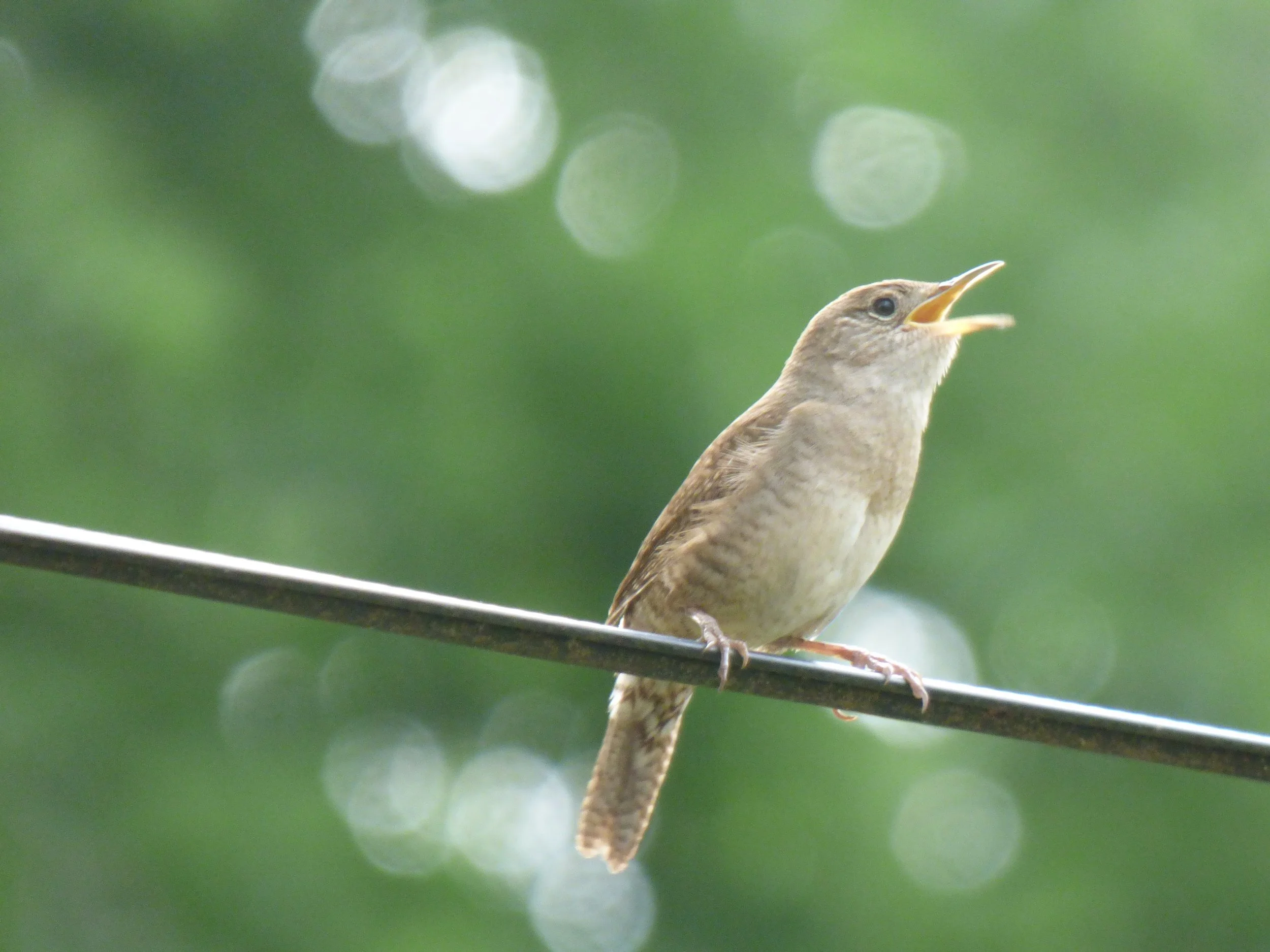
Image description: A Northern House Wren, a small, energetic brown bird whose whole body seems filled with purpose. Their plumage is warm brown with fine barring on the wings and tail. The bill is thin and slightly curved. The tail is down, their expression is bright and alert, and their mouth is open in song. The song of a Northern House Wren is a rush of bright bubbling sound. It begins with a few sharp notes, then tumbles into a rapid series of trills and warbles that seem to spill forward without stopping. The tempo is quick, and the sound seems designed to yell, “I AM HERE!”. Photo by Cat Fribley.Everyone deserves a way into the story of birds. Not simply the chance to identify a species, but the chance to feel what Andrew J. Lewis describes so clearly in this piece we are reprinting below. A shift in attention or a deeper form of listening or even a sense of belonging that does not depend on eyesight or mobility or any single way of taking in the world. This essay, first published by the Cornell Lab of Ornithology and generously shared here with permission from them and the author, speaks directly to the heart of our Blind Birder Bird-a-Thon Community Conversations and to the many ways people with disabilities and other health concerns build their own pathways to joy in nature.
We are reprinting it today as part of our lead-up to the December Community Conversations session with Alli Smith from the Cornell Lab, who will be joining us to talk about Merlin Bird ID. Throughout this season of learning and preparation, our community has been naming the tools and practices that help us move through the world with more ease and less friction. Merlin is one of those tools for many blind and low vision birders and for many disabled birders whose bodies or minds engage most naturally through sound, or who need this tool AS their sound in the case of D/deaf or hard-of-hearing birders. It offers not only identification, but interpretation. It helps people recognize patterns, hold memories, and translate the soundscape into meaning. Andrew’s language for this experience is powerful. He calls it Visceral Technological Kinetic Fulfillment, a term from his professional life as an adaptive technologist working with people with disabilities. Many in our community will recognize that feeling even if they have never had a name for it.
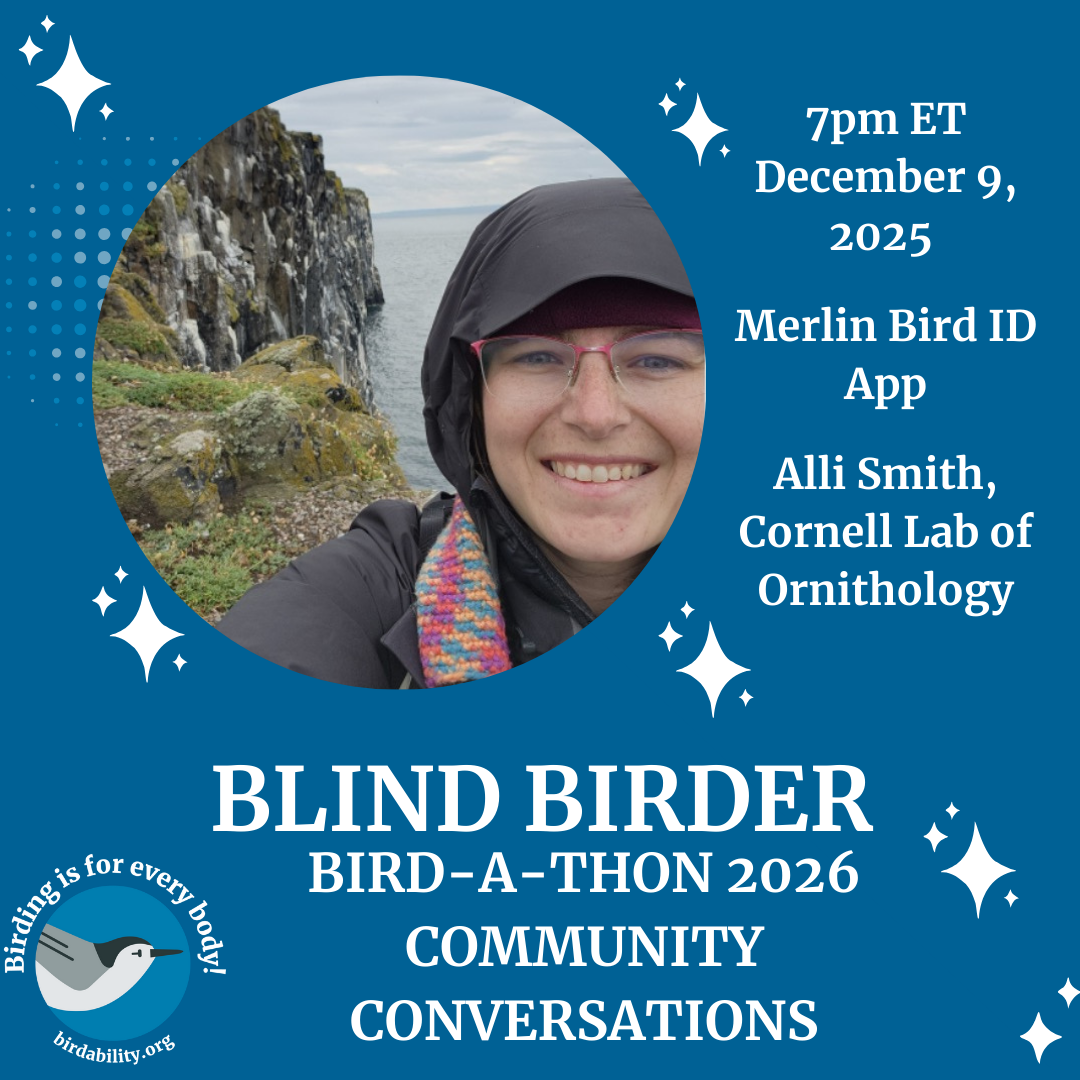
Image description: a graphic with information about the Dec. 9, 2025 Blind Birder Bird-a-Thon Community Conversation featuring Alli Smith from Cornell Lab of Ornithology discussing the Merlin Bird ID app. There is a photo of her, a person with light skin and long brown hair smiling at the camera while standing on a rocky coastal cliffside. She wears glasses with pink frames, a black hooded jacket, and a colorful knit scarf. Behind them, steep cliffs covered in moss and lichen drop down to the ocean, with gray water stretching out toward the horizon under an overcast sky.We are grateful to the Cornell Lab for allowing us to share this piece and grateful to Andrew J. Lewis for offering such a generous reflection on listening, adaptation, and connection. We hope it brings you new insight as we gather tonight with Alli Smith and continue building toward the 2026 global Blind Birder Bird-a-Thon, and a more accessible world of birding and nature for all.
Listening with Merlin Bird ID, I Hear the Patterns We Live By
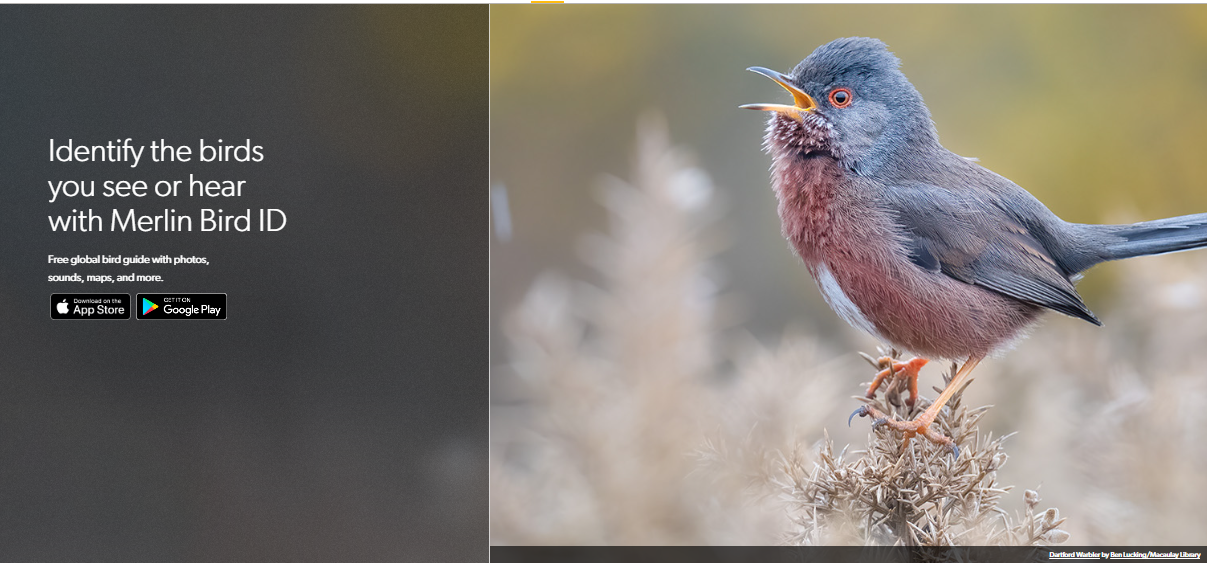
Image description: a wide promotional banner is divided into two sections. On the left, white text against a dark blurred background reads Identify the birds you see or hear with Merlin Bird ID followed by a smaller line describing it as a free global bird guide with photos, sounds, maps, and more. Buttons for downloading the app on the App Store and Google Play are below the text. On the right, a large close up image shows a small songbird perched on pale dried vegetation. The bird has slate blue feathers on its head and upper body, a rust colored chest, and a bright orange eye. Its beak is open mid song, and the soft background appears golden and out of focus.A Merlin Bird ID user finds the app enhances more than just birding. It fosters attention, pattern recognition, even belonging.
Perspective essay by Andrew J. Lewis
June 27, 2025
From the Summer 2025 issue of Living Bird magazine. Subscribe now.
We were car-birding a reed marsh near the Blackwater National Wildlife Refuge in eastern Maryland—me and my uncle Ralph, binoculars trained, trying to make sense of a sparrow that wouldn’t sit still long enough for either of us to be sure. It was one of those midsummer sparrows—muted, flickering in and out of the reeds, unbothered by the debate going on in the car, which were replayed scripts of moments just like these over decades.
I scanned for plumage: faint eyestripe? No, maybe not. Long tail? Vague. We ran the list. Swamp. Seaside. Nelson’s—unlikely in midsummer, but it crossed our minds. The old Sharp-tailed Sparrow grouping still echoed in our shorthand, even though it’s been split for years. Range maps. Habitat. Behavior. Nothing definitive.
And then I heard it—the song. It sounded like a broken catbird—buzzy, abbreviated, like it never quite decided what it wanted to be. As we drove off, I held onto that sound. It stuck with me. It didn’t close the case, not fully. We left the bird marked as “probable, but not definitive.” And therefore: unsatisfying.
Even though the sighting stayed in that frustrating category of “probable,” the moment itself made something else absolutely clear: I don’t ever want to bird again without the Merlin Bird ID app.
That moment in the marsh reminded me: Birding has never just been about identification. It’s about connection. Integration. Feeling a pattern fall into place. And what Merlin—the smartphone app from the Cornell Lab of Ornithology that can identify birds via sound, photos, or a quick step-by-step guide—provides me is a way to stay inside the process, not just observe it. A way to belong.
Because Merlin can do what I no longer can.
I use a power wheelchair now. It’s a relatively recent shift in my life, and while I’m deeply grateful for the mobility it gives me, birding has changed. Holding binoculars steady is harder. I often need to brace on something, and uneven terrain makes that complicated. This isn’t a complaint—and yes, I know there are gear solutions and workarounds. But that’s not what this story is about.
This story is about how Merlin showed me a different way to bird—one that didn’t feel like a compromise. It expanded what I could still do really well: listen.
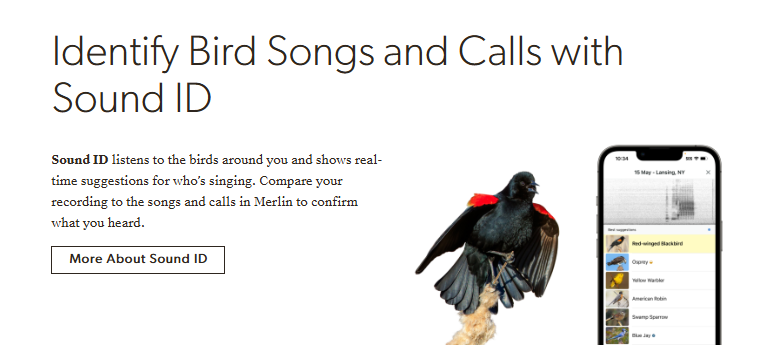
Image description: a graphic shows the text “Identify Bird Songs and Calls with Sound ID” at the top. Below the heading is a short description that explains how Sound ID listens to birds around you and offers real time suggestions for who is singing. A white rectangular button labeled More About Sound ID appears on the left. On the right side of the graphic, a small black bird with bright red shoulder patches lifts its wings while perched next to a smartphone screen. The phone displays a Sound ID result list that includes Red winged Blackbird, Osprey, Yellow Warbler, American Robin, Swamp Sparrow, and Blue Jay, along with a spectrogram image at the top.Because Merlin isn’t just an app, it’s a tool—maybe even a companion—that tunes the world differently. When I sit outside now, I’m not just hearing birdsong. I’m understanding it. I can hear a cardinal and know it’s a spring song—a bright note, a declaration. I can hear a Tufted Titmouse and recognize the call-and-response—a conversation I can finally follow. I can hear the repeating territorial song of a Carolina Wren and understand what that loop is trying to say.
The blur of noise is no longer ambient. It’s a narrative.
And here’s the deeper truth: It’s not just birding Merlin enhances. It’s attention. It’s pattern recognition. It’s belonging.
I call this kind of experience Visceral Technological Kinetic Fulfillment—a term I use in my work as an adaptive technologist who helps people with disabilities use devices or software to meet their unique functional needs. It’s what happens when a well-designed tool doesn’t just extend your senses—it aligns with your way of being. It removes friction between perception and meaning. It doesn’t force you to become someone else. It lets you become more fully who you already are.
That’s what Merlin does for me. I don’t want to watch birds like I used to. I want to listen to birds like I can now.
I’ve always been someone who follows sound. I remember the first time I ever heard an Eastern Phoebe in Connecticut—its raspy, insistent phoebe!-phoebe! song—plainspoken and persistent, a familiar voice calling from the edge of a quiet wood. That sound has never left me. And now, even if my legs can’t carry me up a hillside trail, Merlin can help me know when that bird is near. I can listen for it, confirm it, and still feel part of the world it lives in.
Image description: a blue square graphic with the quote below, and the author’s name, Andrew J. Lewis, along with a Birdability logo and some graphic white stars.Merlin is also, quietly, one of the most accessible tools I’ve ever used. If your body is unable or your eyes aren’t sharp, you can listen. If your hearing’s not great, you can follow the spectrogram or read the names. If you’re neurodivergent, the structure and clarity can light up your brain in the best way. And if you’re just someone trying to feel connected again—to place, to rhythm, to the world—Merlin delivers. Gently. Instantly. Reliably.
We don’t talk enough about what these tools do to us, not just for us. What they open up. How they change the way we walk through the world. Merlin is marketed as a birding assistant. What it really is, for me, is an access portal. To the natural world. To joy. To memory. To narrative.
Here’s the thing: I’m not a lister. I’ve never kept count, never flown across the country for a rarity, never chased the big year. I’ve seen most of the easy, colorful birds here in North America. What’s left for me now are the sparrows, the shorebirds, the gulls and terns—birds that all blur together unless you really know how to look or listen. And sometimes, it feels like work. But it’s the kind of work I’m drawn to—the kind that asks not just for identification, but for something deeper.
I’ve come to think of myself as a fulfillment birder. I don’t need genetic confirmation or a second opinion from a rare bird alert. I don’t mind seeing the same bird again and again. I still target species—sometimes even plan family trips around them. (That Great Gray Owl at Sax-Zim Bog? Worth every mile.) But the thrill isn’t in the chase. It’s in the alignment—when all the cues come together, and something inside me just knows. That’s the bird. That’s the moment. That’s the story.
And yes, I avoided Merlin at first. It felt like cheating. Like outsourcing the part of birding that was supposed to be hard earned. But I’ve changed my mind. Merlin doesn’t replace the story—it reveals it. Last spring, I used it to track down a Wood Thrush I was hearing but couldn’t see. When I finally spotted it, I realized it was gathering nesting material—and had been calling in that particular rhythm for a reason. That’s what Merlin helps me do: catch the layer beneath the sound.
And that’s how I know: I still belong. Maybe not always with those listing their sightings. But definitely in the story about birds and the natural world. That day in the refuge, puzzling over sparrows with my uncle, showed me I had crossed some kind of line. From passive birder to participant in pattern. From seeker to interpreter.
I’ve never heard birdsong the same way since.
And I don’t ever want to go back.
About the Author
Andrew J. Lewis is a writer and adaptive technologist based in Maryland, where he lives with his wife, son, and daughter, Phoebe. His work explores how people re-author their lives after trauma, illness, or identity disruption. His book A Democracy of Facts—about American ornithologists and naturalists during the era of the American Revolution—was published in 2011 by the University of Pennsylvania Press. He’s been writing about birds since a second-grade report on the Peregrine Falcon.
