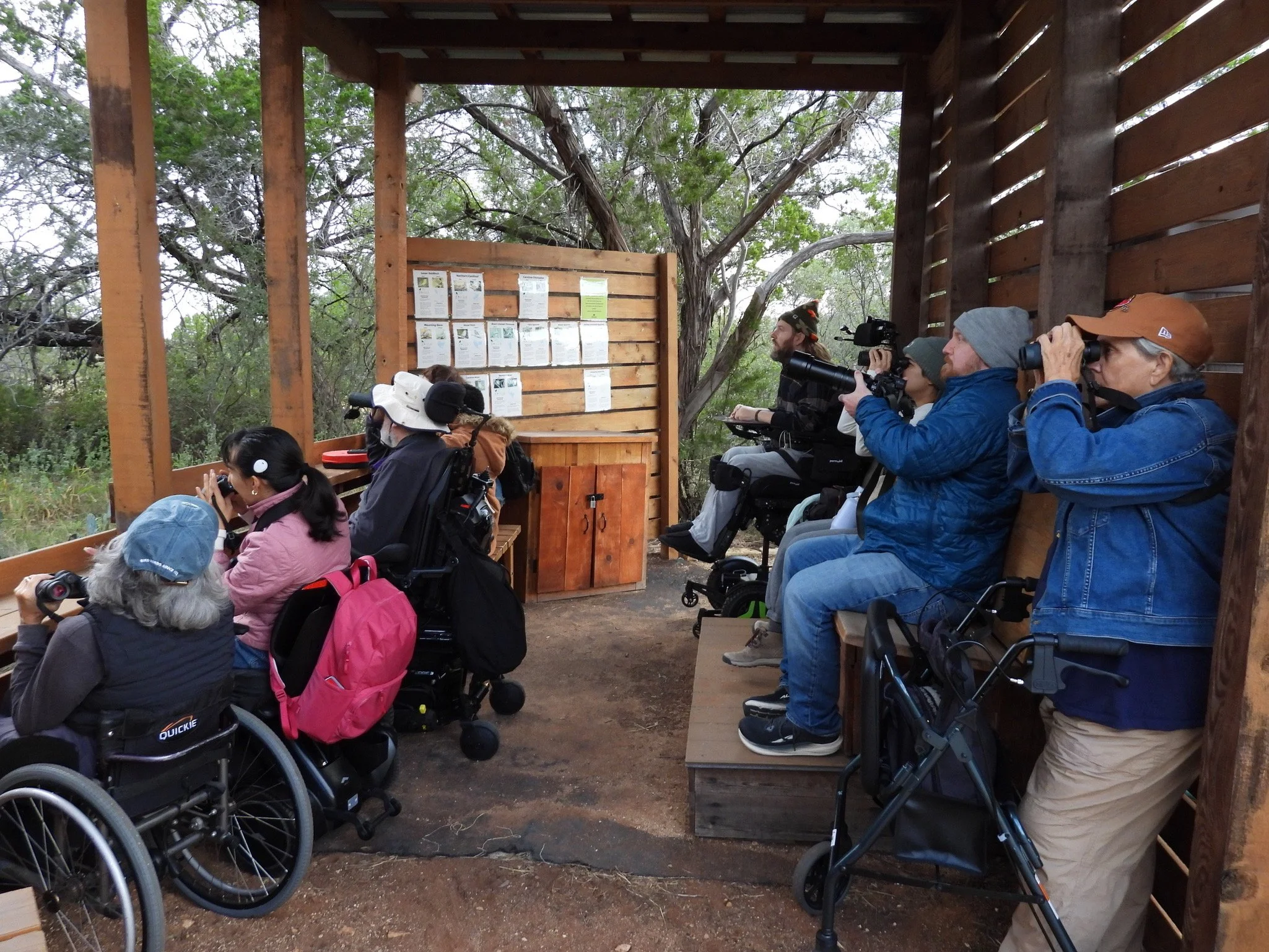
Image description: Birdability Captain and Founder Virginia Rose and Birdability Captain Eric Clow at a Birdability outing featuring a morning of accessible birding at the gorgeous Westcave Preserve accessible bird blind. Nine people, many using wheelchairs or other mobility devices(as well as binoculars and cameras), gather in a bird blind with a flat, accessible surface, with a high roof, some risers and benches for those who sit, and an open design for bird observation in the front. There is a wooden wall to the left with flyers and bird information posted on it.As 2025 comes to a close, many of our conversations with Birdability Captains and our broader Birdability community have focused on reflecting on the last year and what comes next. These conversations were with people doing the day-to-day work of access and inclusion in their own communities. Across year-end meetings and discussions, the same ideas came up again and again.
Birdability is about community and shared action for accessibility.
Throughout 2025, we saw astonishing growth in interesting places. This growth was specific and rooted in lived experience. There was no single definition of success. Instead, Captains and our community described a growing understanding of how to approach leadership, conservation, access, and belonging in ways that truly serve their communities.
Captains shared a strong need for spaces where conservation, access, and disability justice are connected. Many described relief at being in rooms where accessibility was the starting point. Conversations about trails, bird counts, mapping, equipment, and partnerships were strongest when access was framed as a shared responsibility, not a test or a standard to meet. That approach then spread into local communities in meaningful ways. Captains shared:
“Because of participation in the Birdability project, I was able to advocate for accessibility, and now it’s actually happening.”
“Birdability gave me the language to explain that this isn’t a grade or an audit. It’s information.”
“This helped shift how our organization thinks about access as something we can plan for.”
“Birdability resources played an important role in helping us put together our DEI policy statement.”
Again and again, Captains returned to the idea that information itself is a form of access. Clear and honest information helps people decide what works for them. Whether the topic was site reviews, Birdability Map data, loaner closets, or adaptive equipment, detailed information reduced barriers.
Belonging came up in nearly every year-end reflection. Captains described Birdability as a space where questions, unfinished ideas, and lived experience are welcome. Humor, storytelling, and informal check-ins helped make the work sustainable. Knowing others were facing similar challenges reduced burnout and built confidence. Captains shared:
“…the relief is knowing you’re not doing this work alone.”
“Slowing down changed everything about how people experienced the outing.”
“Flexibility wasn’t a failure. It was part of access-centered planning.”
“This work feels sustainable because it’s collective.”
These reflections (all from meetings of our Captains and community members) match what we experienced as an organization in 2025. We welcomed another cohort of Let’s Go Birding interns and deepened partnerships with national parks. We invested in future leaders grounded in access and inclusion and our Captains led the way. Birdability Week 2025 grew into a more connected celebration across North America, with more than 110 local events and dozens of virtual ones. We launched the Birdability Captain Conservation Corps (BC3) in January and grew our BC3 membership of conservation professionals working toward accessibility and inclusion to 84. We expanded the Birdability Outreach Program into new settings, introducing many folks with disabilities to birding for the first time. We celebrated the first Blind Birder Bird-a-thon with more than 200 participants and continued building toward the 2026 Bird-a-thon that will be held globally May 3-4, 2026.
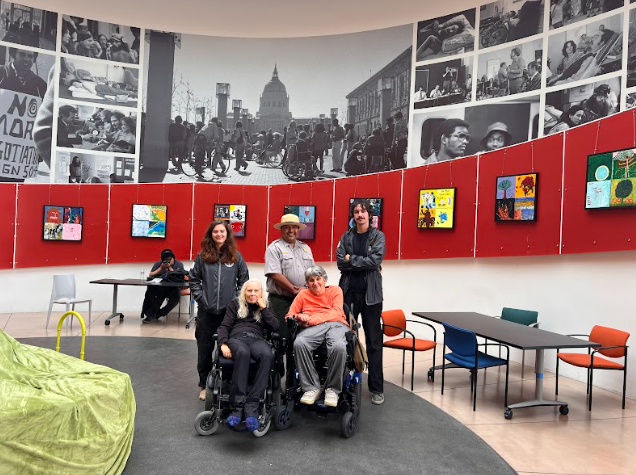
Image description: Let's Go Birding Intern Zoe, Site Supervisor Richard De la o, and Intern George, visiting Bay Area Outreach and Recreation Program's Judy Smith and Bonnie Lewkowicz, as they worked at Golden Gate National Recreation Area on accessible birding programs. The group of five, two using wheelchairs in front, are on a large space with large photos of disability justice around them, and colorful paintings on a bright red wall. From all of this, a few lessons stand out.
Accessibility spreads. When people experience inclusive design and culture, they bring those lessons back to their own communities.
Partnerships increase impact. Collaborations across sectors, from optics to tourism to disability centers and public lands, show that everyone has a role in building access - and sometimes the right partner is in a surprising place!
Stories change systems. The voices of disabled birders are shaping outdoor recreation, policy, and how people think about access with every event, every outing, and every opportunity to hear from our community.
None of this happened because of one person. It happened because hundreds of people said yes. Yes to learning. Yes to showing up. Yes to doing the slow and sometimes messy work of inclusion together.
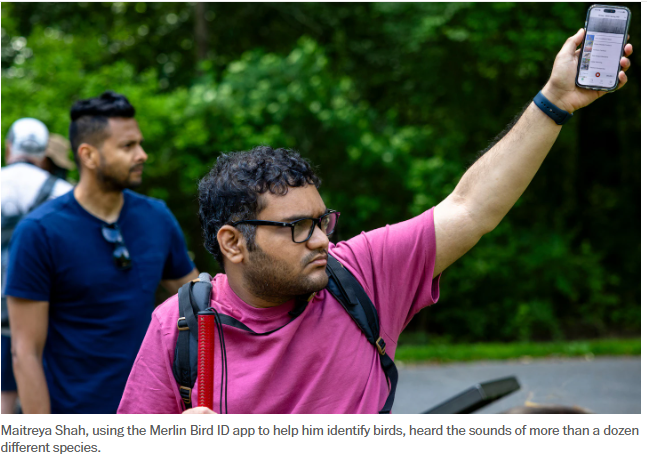
Image description: A photo from the Blind Birder Bird-a-Thon outing at Brookside Gardens covered by the Washington Post. A person dressed in pink shirt and holding a cell phone in the air with the Merlin Bird ID App pulled up and identifying birds, stands with a white cane, while another birder in a blue shirt stands behind looking into the woods. https://www.washingtonpost.com/dc-md-va/2025/05/21/blind-birders-bird-a-thon-brookside-gardens/ As Captains looked ahead to 2026, their hopes were clear. Even stronger local connections. Continued learning about disability justice. More tools and shared leadership at the local and national level. A continued commitment to centering disabled birders and honoring the many ways people come to birds and to nature.
As we move into a new year, we want to ask you a question we have been asking ourselves.
Where did you grow in 2025?
Maybe it was in how you engage with birds. Maybe in how you show up for your community. Maybe in learning to ask for what you need, or realizing you are allowed to take up space here. For many, growth came from deepening their understanding of access and putting that learning into practice.
As we move toward 2026, we invite you to share those reflections with us. By naming what has changed, celebrating what took root in 2025, and imagining what accessible birding can become when we build it together, we will continue to GROW into 2026 and beyond.
Thank you for being part of this community. Thank you for shaping Birdability. We look forward to continuing to grow together.
