
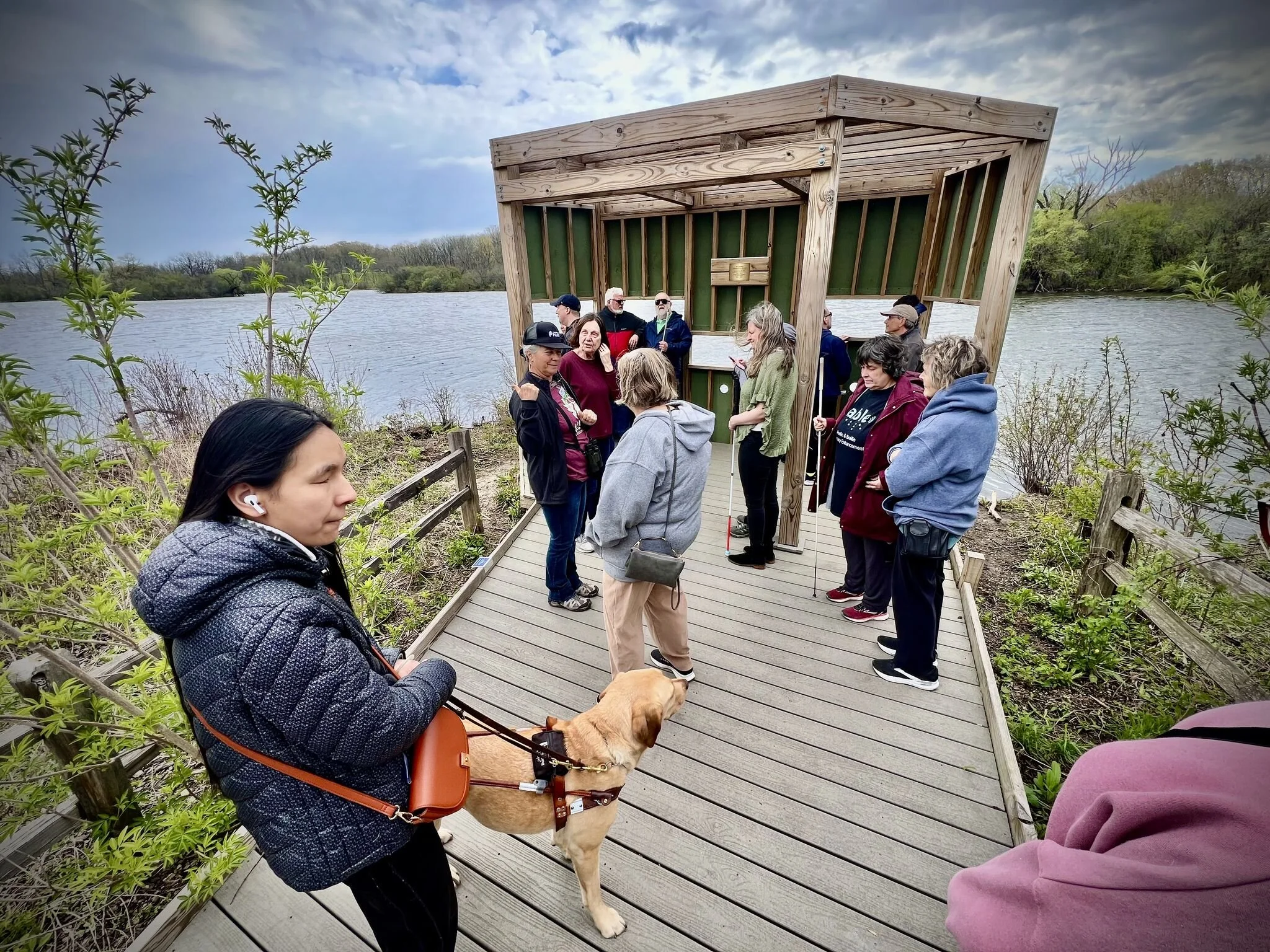
Image description: A group of about a dozen people participating in the 2026 Blind Birder Bird-a-Thon gathers on a wide, accessible wooden boardwalk overlooking a lake at Wehr Nature Center. The group is standing around an open sided bird blind with a roof, talking. Several participants are using white canes, and one person stands in the foreground with a yellow guide dog wearing a harness. Others wear binoculars or cameras around their necks. The boardwalk has railings and provides level access to the bird blind. Trees and shrubs line the shoreline, and the lake stretches into the distance beneath a dramatic sky filled with layered gray and blue clouds.When the second annual Blind Birder Bird-a-Thon wrapped up, the numbers were impressive.
Almost 300 registered participants joined from more than 10 countries and territories. Participants represented 35 states, Washington, DC, Puerto Rico, Canada, Venezuela, South Africa, the United Kingdom, Australia, Italy, and Mexico. Together, participants heard and identified 355 bird species across the globe. Community events took place across North America and beyond.
But when participants gathered for the wrap-up celebration call, the numbers were only a tiny bit of the story. Participants talked about joy and learning and the birds they heard (including a Wedge-tailed Shearwater, which was breeding near the hotel where one participant was staying in Hawaii!). Most of all, though, they talked about belonging.
One participant, Natanya Sortland, captured that feeling perfectly.
Before the Bird-a-Thon even began, she wrote to share how much the event meant to her.
"I just don't have the words to express how I feel about this event. It gives me so much joy that I could literally cry."
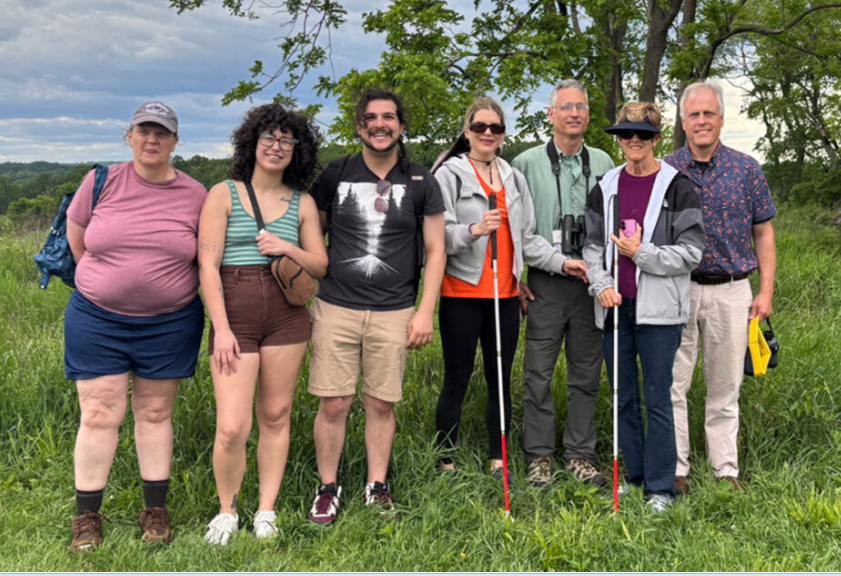
Image description: Seven participants in the Blind Birder Bird-a-thon stand together with Natanya Sortland in a grassy field with trees and a cloudy sky behind them, smiling for a group photo. Two participants are holding long white canes, and one is wearing dark wraparound glasses. Another participant has binoculars hanging around their neck for the 2025 event.During the wrap-up call, she explained why.
"I didn't feel alone," she said. "I woke up really excited, and I was like, okay, this is awesome. I'm connecting."
Natanya shared that she had spent many years feeling isolated.
"I was lonely and isolated for a very, very, very long time," she said. "And let me just tell you, like, all of you, I'm like, I'm with my people!"
That sense of connection echoed throughout the conversation.
For Donna Hill, participating in the Bird-a-Thon meant spending time with birds from her rural Pennsylvania home.
"Being a participant in the second annual blind birder Bird-a-Thon has been both magical and healing," she said.
Unable to sleep before the event, Donna got up early to experience the dawn chorus, something she said she had not done in years. Despite cold temperatures and rainy weather, she spent time recording birds and identifying species she recognized from years of living in the area.
"My homework now is to identify the ones that are still baffling me," she wrote.
Others discovered entirely new ways of experiencing birds.
Intesar from Iowa City shared how learning to use bird identification tools changed the way she listened to the world around her.
"Each time I hear a bird, I run outdoors and try to record it," she wrote.
"I am really enjoying this hobby. I always love listening to bird songs, but never knew what kind of birds they are."
Cat Peever had a similar experience.
After participating in Birdability's training sessions and using Merlin to learn birdsongs, she found herself returning to her local park again and again.
"I had to spend the next 2 days wandering in my local park listening to bird song with 'new ears' to hear it," she wrote. "I want to learn more."
She ended her reflection with words that perfectly captured the spirit of the weekend.
"As far as the prize only being available to US participants, I feel like I have already been given a prize. I had a wonderful experience and that feels like a gift."
For some participants, the Bird-a-Thon opened doors to entirely new possibilities.
During the wrap-up call, Razz Terizzi shared that moving to a new location had revealed a world full of birds they had not realized was there.
Video description: Broad-tailed Hummingbird males vie for a perch. Males are aggressively territorial and chase off intruders. Males can make a very loud trilling noise with their wings. Video recorded by Larry Arbanas/Macaulay Library/http://macaulaylibrary.org/video/466294"This has become one of my favorite things," Razz said. "I know it's only happened twice, but I love the Birdathon."
One highlight was spending days listening to hummingbirds defend their territory.
"I was able to listen to a hummingbird defending his territory for a total of like three straight days against several different males, and I could hear the difference between them."
Reflecting on the experience, Razz said:
"I'm just really glad you guys brought all this to the attention of people like me, so we found out, like, I can actually do this."
That theme surfaced again and again.
Participants were not only identifying birds. They were building skills, confidence, and community.
In California's Birchim Canyon, Carol Huston birded with friends who described the landscape while she identified birds by sound. Together they listened for wrens, towhees, grosbeaks, and warblers. Along the way, they explored willow leaves, cottonwood bark, and the sounds of the canyon.
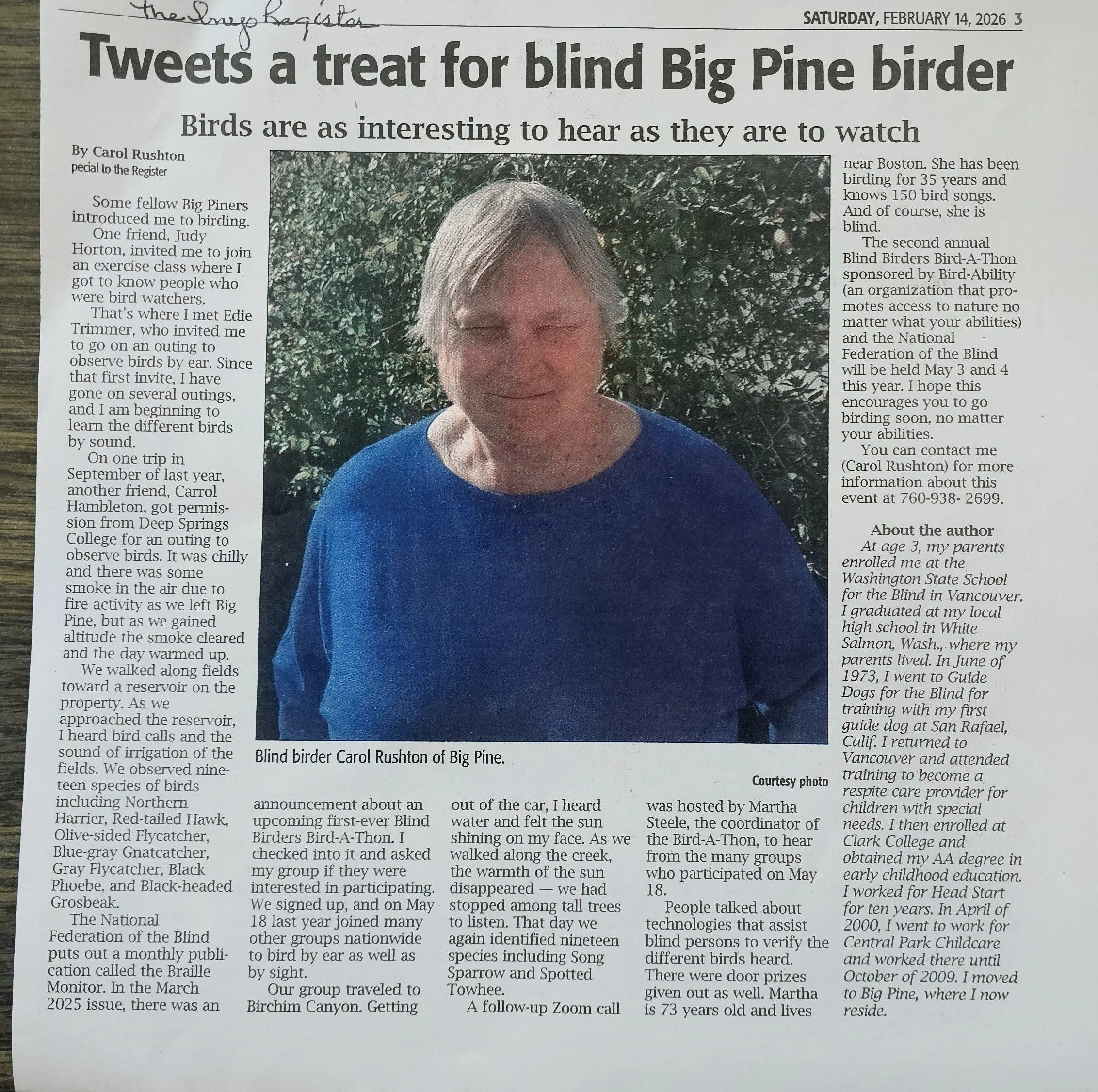
Image description: A newspaper page from The Inyo Register dated Saturday, February 14, 2026, features the headline "Tweets a treat for blind Big Pine birder" with the subheading "Birds are as interesting to hear as they are to watch." The article, written by Carol Rushton, describes her experiences as a blind birder, learning to identify birds by sound, and participating in the Blind Birder Birdathon. The center of the page includes a large color portrait of Carol Rushton standing outdoors in front of leafy shrubs, wearing a bright blue shirt and smiling gently toward the camera. A caption beneath the photo reads, "Blind birder Carol Rushton of Big Pine." The article includes details about birding by ear, the National Federation of the Blind, Birdability, and the second annual Blind Birder Birdathon, encouraging readers to explore birding regardless of ability. A sidebar on the right shares a brief biography of Carol Rushton, including her lifelong experience with blindness, guide dog training, career, and move to Big Pine.Later, one participant reflected on what made the experience memorable:
"The best part was moving through the canyon together, listening, noticing, and letting sound and touch guide the day."
Around the world, similar stories unfolded.
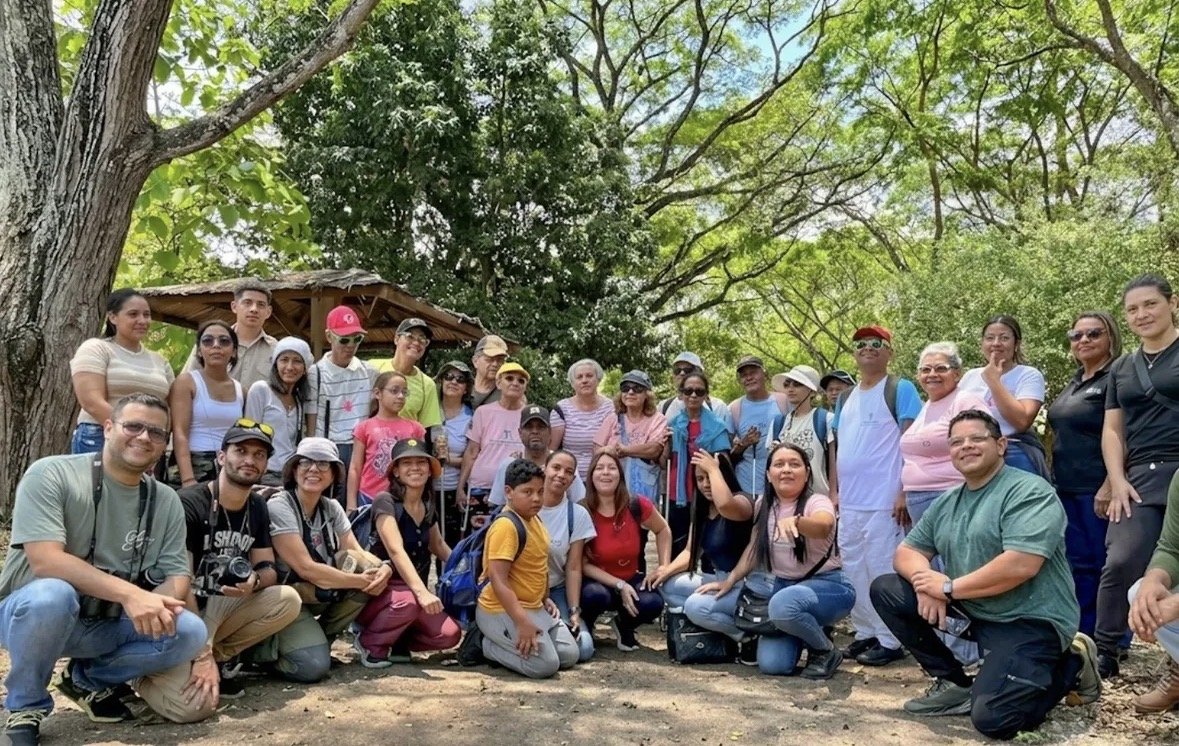
Image description: A large group of approximately 30 participants gathers for a group photo during a Blind Birder Bird-a-Thon event in Venezuela. The group includes adults, children, and older adults standing and kneeling beneath the shade of large trees. Several participants hold white canes, while others wear binoculars or carry cameras, backpacks, and birding gear. The diverse group smiles toward the camera, with a rustic wooden shelter visible behind them and lush green vegetation surrounding the gathering. The photo reflects a welcoming, multigenerational community brought together through accessible birding.More than 30 people participated in Venezuela’s second celebration of the event, held in collaboration with Celebate Urban Birds from Cornell Lab of Ornithology and AveZona, a community-based organization working in Venezuela to connect people with birds.
A team in South Africa consisting of 14 blind participants and 5 sighted guides identified 69 species together in Dinokeng Game Reserve.
A Blind birder traveling the Camino de Santiago in Spain participated and later made a video for other blind birders to be able to share her experience and the birdsong she was hearing.
Video description: A blind woman sits on a low concrete wall in a shady park or woodland area, speaking directly to the camera. She wears a bright pink short sleeved shirt, black leggings, gray sneakers, and a smartwatch. Beside her are multiple backpacks, one light gray and one teal, with one purple. Trees, dense green vegetation, and a gravel path surround the area. The camera remains steady in a medium shot as she talks, occasionally smiling and gesturing naturally while seated. She is describing the scents along the trail and the sounds of the birds that you can hear behind her.In Wisconsin, participants explored accessible trails, listened for birds, and connected through shared experiences in nature. In Ontario, members of the Canadian Council of the Blind learned birdsongs and experienced chickadees landing directly on their hands to take seeds.
For Michael Diaz, a blind birder and participant in Wisconsin, the Bird-a-Thon represented something larger.
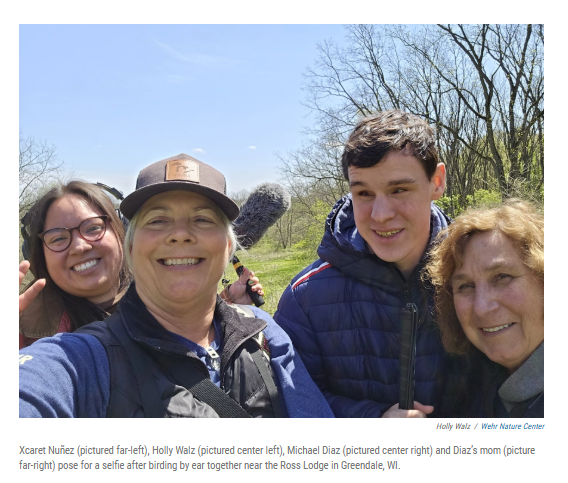
Image description: A close up selfie shows four participants smiling after a birding by ear outing at Wehr Nature Center near the Ross Lodge in Greendale, Wisconsin. From left to right are Xcaret Núñez (host who recorded https://www.wuwm.com/chirp-chat-learning-about-joy-birding-by-ear for WUWM, Milwakee's NPR Station) , Holly Walz, Michael Diaz, and Diaz's mother. Holly, standing in the center foreground, wears a baseball cap and dark vest and holds the camera for the selfie. Michael wears a blue puffer jacket and smiles toward the camera, while his mother stands beside him. Xcaret smiles and gives a peace sign from the left edge of the photo. A fuzzy microphone windscreen is visible behind the group, suggesting audio recording during the event. The background includes a grassy field, leafless and budding trees, and a bright blue spring sky. Beneath the photo is a caption identifying the participants and noting that they were birding by ear together near the Ross Lodge in Greendale, Wisconsin."I'm so glad that this exists for blind people," he said during the wrap-up call, "because it shows that anyone can bird."
As the celebration call drew to a close, Bird-a-Thon cofounder Martha Steele reflected on the stories she had heard.
"I'm emotional," she admitted.
Then she explained what birding by ear means to her.
"I used to see, but could not hear birds."
After receiving cochlear implants, she experienced birdsong in an entirely new way.
"One of the things about birds is, especially listening to them, is that you can just stand there, and the sounds come to you."
Then she shared a thought that seemed to resonate with everyone on the call.
"You're there, you're alone with your bird. It's just exquisite."
Jerry Berrier reflected on the spring that the Bird-a-Thon had created.
"This has been the best birding spring I think I've ever had," he said.
And then, simply:
"It's a beautiful thing."
Finally, Donna Posont brought the conversation back to the original purpose of the Bird-a-Thon.
"One of our main goals was to get us outside as blind people to enjoy nature and the creation and listen for the birds."
After hearing the stories shared throughout the evening, she offered a brief assessment of whether the event had succeeded.
"Mission accomplished."
After listening to participants describe joy, friendship, discovery, confidence, awe, and community, it is hard to argue with that conclusion.
Media coverage of the event:
https://www.nhpr.org/2026-05-27/visual-impairments-dont-keep-these-birders-out-of-the-hobby
https://ontarionature.org/blind-birders-building-more-inclusive-birding-community-blog/
https://in-sight.org/2026/05/02/insightful-birding/
